Your Success Doesn't Threaten Mine, So Why Does Mine Threaten Yours?
Some people see their friends succeeding and feel inspired. Others see the same success and silently start competing. I have never understood why.

Some people see their friends succeeding and feel inspired. Others see the same success and silently start competing. I have never understood why.
Some people see their friends succeeding and feel inspired. Others see the same success and silently start competing. I have never understood why.
I remember something that happened during my college days. I secured the first rank in my third year. It was a moment of happiness for me, something I had worked hard for and was genuinely proud of.
But what surprised me wasn't my achievement. It was a conversation with someone I considered my best friend.
She admitted that she was jealous of me. Not just a little jealous. She told me that there were moments when she felt so jealous that she wanted to slap me.
I remember wondering, why?
Why would my achievement make someone I loved and trusted feel that way? Why couldn't my happiness simply be her happiness too?
I wasn't taking anything away from her. My success didn't mean she had failed. My rank didn't mean she couldn't achieve something equally wonderful, or even greater.
And yet, somehow, my achievement had become a reason for resentment.
That conversation stayed with me.
Not because I wanted to hold a grudge, but because it made me question something much bigger.
Why do we sometimes find it so difficult to celebrate the success of people closest to us?
Friendship Shouldn't Feel Like a Competition
I have always believed that friendship is not about who reaches the finish line first.
Life isn't a race where only one person gets to win.
If my friend becomes successful before me, I want to celebrate. If she gets an opportunity I haven't received yet, I want to encourage her. If she achieves something extraordinary, I want to be among the first people cheering for her.
Because her success doesn't make me unsuccessful.
And my success shouldn't make her feel inferior.
We all have different journeys, different struggles, different opportunities, and different timelines.
Someone might become financially independent at 22. Someone else might find their calling at 30. One person might excel academically, while another might build something extraordinary professionally.
Why do we constantly compare these journeys?
Why can't we simply appreciate that everyone is growing in their own way?
I don't want friendships where we secretly measure who earns more, who achieves more, who has better opportunities, or who is doing better in life.
I want friendships where we can sit together, talk about our dreams, share our achievements, discuss our failures, and genuinely want the best for one another.
I Don't Want to Be Successful Alone
There is something about me that I don't think will ever change.
I don't want to reach the top and look around to find myself standing there alone.
I want my friends to succeed.
I want them to achieve things they once thought were impossible. I want them to become financially independent, professionally successful, confident, knowledgeable, and happy.
I want them to get the opportunities they deserve.
And if there is something I can do to help them reach that point, why wouldn't I?
If I know something that could help someone, I share it.
If I understand a concept that someone else is struggling with, I explain it.
If I come across an opportunity that might benefit a friend, I tell them about it.
If someone needs encouragement because they are doubting themselves, I try to remind them of what they are capable of.
Not because I expect them to return the favour someday.
Not because I want them to owe me something.
Not because I am trying to build some kind of personal influence.
I do it because seeing people grow genuinely makes me happy.
And maybe this sounds a little childish, but I have always imagined something.
One day, when all my friends are doing incredibly well in their lives, I want us to sit together, look back at where we started, laugh about our struggles, celebrate how far we have come, and party hard.
Not because one of us made it.
But because all of us did.
That, to me, is a beautiful definition of success.
Why Is Kindness Always Suspected of Having a Motive?
Another thing I have experienced is how people sometimes misunderstand genuine support.
When you help someone repeatedly, they begin wondering what you want in return.
When you share your knowledge freely, they question why you're doing it.
When you encourage someone without expecting anything, they sometimes assume there must be some hidden intention.
And I find that strange.
Have we reached a point where kindness feels suspicious?
Where helping someone without personal benefit seems unbelievable?
I understand that the world isn't always kind. People have experienced manipulation, selfishness, and relationships built on convenience. Maybe that is why some people struggle to trust genuine intentions.
But not everyone operates with an agenda.
Some people genuinely enjoy giving.
Some people find happiness in helping others understand something they didn't know yesterday.
Some people believe that knowledge becomes more valuable when it is shared.
And I happen to be one of those people.
Knowledge Was Never Meant to Be Hidden
I have never understood the idea of deliberately withholding knowledge just to stay ahead of someone else.
If I have learned something useful, why should I keep it to myself?
What exactly am I afraid of?
That someone might become better than me?
That someone might use the same knowledge and achieve more?
If that happens, shouldn't it be something worth celebrating?
I love teaching people. I love explaining things. I love watching someone go from saying, "I don't think I can do this," to confidently saying, "I understand it now."
Whether it is my juniors, seniors, classmates, colleagues, friends, or family members, I have always wanted to share whatever I know.
And I don't believe sharing my knowledge makes me less capable.
In fact, every time I explain something to someone, I learn something myself.
Sometimes they ask questions I hadn't considered. Sometimes their perspective makes me rethink my own understanding.
Learning doesn't have to be a competition.
Knowledge isn't a candle that burns out when you light another.
Helping someone become better doesn't make you smaller.
It simply means that two people are growing instead of one.
Maybe Jealousy Is Human, but What We Do With It Matters
Over time, I have also realised something.
Feeling jealous doesn't automatically make someone a bad person.
We are human. We compare ourselves. We feel insecure. Sometimes another person's achievement reminds us of something we haven't accomplished yet.
Perhaps jealousy is not always about disliking someone else's success. Sometimes it is about feeling disappointed with our own progress.
But there is a difference between experiencing jealousy and allowing that jealousy to turn into resentment.
You can feel insecure and still congratulate your friend.
You can wish you had achieved something and still be happy that someone close to you did.
You can admire someone's progress without turning their life into a competition with yours.
And perhaps that is what emotional maturity looks like.
Not never feeling jealous, but refusing to let jealousy destroy relationships.
I Will Continue Being Who I Am
I know not everyone will understand my intentions.
Some people will appreciate my support. Some will question it. Some might misunderstand my kindness. Others may take it for granted.
And I am learning that I cannot control how people interpret my actions.
I can only control the person I choose to be.
Of course, being a giver doesn't mean I should allow people to disrespect me or take advantage of me. Kindness and boundaries can exist together.
I can continue helping people while also learning where my energy is valued.
I can wish someone well without needing to remain close to them.
And I can celebrate someone's success even if they are unable to celebrate mine.
Because ultimately, their reaction reflects their perspective, not the value of my achievements.
I don't want someone else's insecurity to change the way I look at the world.
I don't want one disappointing friendship to make me suspicious of every friendship that follows.
I don't want to become someone who hides opportunities, withholds knowledge, or feels threatened by another person's growth.
That simply isn't who I am.
There Is Enough Room for All of Us to Grow
I hope we can build friendships where success is celebrated rather than compared.
Where one person's achievement becomes an inspiration rather than a threat.
Where we share opportunities instead of hiding them.
Where we help each other become better without keeping score of who has done more for whom.
Because I genuinely believe that the people around us should not have to become smaller for us to feel bigger.
I want my friends to win.
I want my juniors to surpass me.
I want the people I teach to become more knowledgeable than I am.
I want the people I support to achieve things I haven't even imagined for myself.
And when they do, I want to be able to say, with genuine happiness, "Look how far you've come."
I don't want to be the only successful person in my circle. I want to be surrounded by successful people, knowing that we encouraged each other when we were still figuring life out.
So, if you are my friend, please understand one thing.
I am not competing with you.
I am rooting for you.
And I hope that when something wonderful happens in my life, you can root for me too.
Because at the end of the day, I don't want to win against my friends. I want to win alongside them.
— Advocate Sonali Agrawal
Comments
You may also like

The Doctrine of Res Judicata under Section 11 CPC: Finality of Litigation and Its Limits
Courts exist to resolve disputes, not to keep them alive indefinitely. Section 11 of the Code of Civil Procedure, 1908 (CPC), embodies this principle through the doctrine of res judicata, which prevents parties from reopening matters that have already been finally decided by a competent court. The doctrine protects litigants from repeated proceedings, preserves judicial resources, and gives authority to judicial decisions. However, applying res judicata requires more than establishing that two cases concern similar facts. The nature of the earlier decision, the identity of the parties, the issues adjudicated, and the competence of the court must all be examined. The eight Explanations appended to Section 11 clarify the scope of the doctrine and address situations in which a matter may be treated as already decided, even when it was not expressly determined in the earlier proceedings.

The History of Organisational Psychology in India and Its Connection with Labour Laws
Organisational psychology examines how people behave within organisations, how management influences their performance, and how workplace relationships affect decisionmaking. In India, its development can be understood alongside the country's industrial history, from colonial-era factories to modern corporate workplaces. Although organisational psychology emerged as a distinct discipline largely through Western research, the questions it addresses became increasingly relevant in India as industrial employment expanded and concerns about working conditions, worker representation, and managerial authority grew. The history of Indian labour legislation provides a useful timeline for understanding how the relationship between organisations and the people working within them has changed. From Industrial Control to Human Behaviour 1881–1947: Colonial industrialisation and factory regulation The expansion of factories, railways, mines, and plantations under British rule created a growing need to organise industrial labour. Early management practices emphasised discipline, productivity, and supervision, while workers faced concerns about working hours, safety, and welfare. The Factories Act, 1881, marked an early attempt to regulate factory employment in India. It was followed by further legislation, including the Factories Act, 1948, which developed a broader framework for factory health, safety, and welfare.
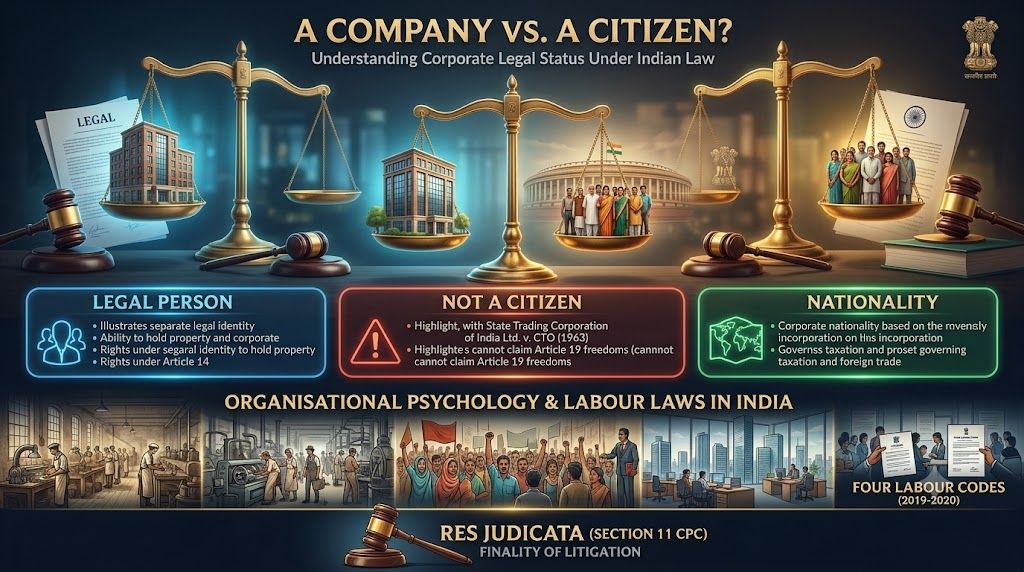
Is a Company a Citizen or a National? Understanding the Position Under Indian Law
Can a company incorporated in India claim the same constitutional status as an Indian citizen? At first glance, the answer might appear obvious. A company may be established under Indian law, conduct business within the country, employ Indian citizens, and contribute significantly to the national economy. Yet, despite its distinct legal identity, a company does not enjoy every right available to an individual. This distinction came into sharp focus before the Supreme Court of India in State Trading Corporation of India Ltd. v. Commercial Tax Officer, AIR 1963 SC 1811, a landmark judgment that clarified the constitutional position of companies and established an important distinction between legal personality, citizenship, and corporate nationality.