Is a Company a Citizen or a National? Understanding the Position Under Indian Law
Can a company incorporated in India claim the same constitutional status as an Indian citizen? At first glance, the answer might appear obvious. A company may be established under Indian law, conduct business within the country, employ Indian citizens, and contribute significantly to the national economy. Yet, despite its distinct legal identity, a company does not enjoy every right available to an individual. This distinction came into sharp focus before the Supreme Court of India in State Trading Corporation of India Ltd. v. Commercial Tax Officer, AIR 1963 SC 1811, a landmark judgment that clarified the constitutional position of companies and established an important distinction between legal personality, citizenship, and corporate nationality.
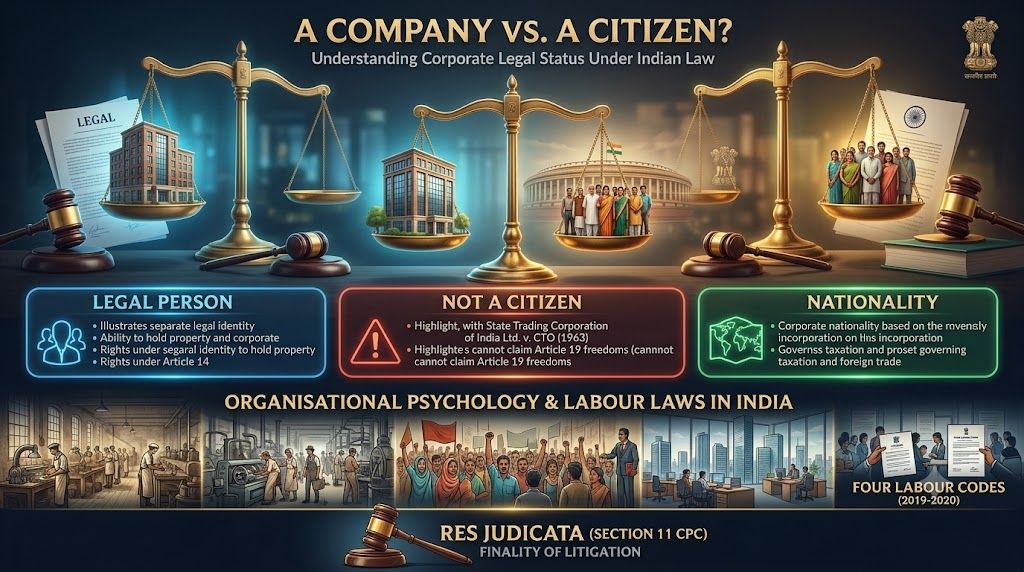
Can a company incorporated in India claim the same constitutional status as an Indian citizen? At first glance, the answer might appear obvious. A company may be established under Indian law, conduct business within the country, employ Indian citizens, and contribute significantly to the national economy. Yet, despite its distinct legal identity, a company does not enjoy every right available to an individual. This distinction came into sharp focus before the Supreme Court of India in State Trading Corporation of India Ltd. v. Commercial Tax Officer, AIR 1963 SC 1811, a landmark judgment that clarified the constitutional position of companies and established an important distinction between legal personality, citizenship, and corporate nationality.
Can a company incorporated in India claim the same constitutional status as an Indian citizen? At first glance, the answer might appear obvious. A company may be established under Indian law, conduct business within the country, employ Indian citizens, and contribute significantly to the national economy. Yet, despite its distinct legal identity, a company does not enjoy every right available to an individual. This distinction came into sharp focus before the Supreme Court of India in State Trading Corporation of India Ltd. v. Commercial Tax Officer, AIR 1963 SC 1811, a landmark judgment that clarified the constitutional position of companies and established an important distinction between legal personality, citizenship, and corporate nationality.
The Case: State Trading Corporation of India Ltd. v. Commercial Tax Officer
The State Trading Corporation of India Ltd. was incorporated under Indian law and engaged in commercial activities, including international trade. A dispute arose concerning the imposition of sales tax, following which the Corporation approached the Supreme Court under Article 32 of the Constitution, alleging a violation of its fundamental rights. The central question was whether a company incorporated in India could claim the freedoms guaranteed under Article 19, which are expressly available to citizens.
The Corporation's claim raised a fundamental question of constitutional interpretation. If an entity is created under Indian law, operates within the country, and is recognised as a separate legal person, can it also be regarded as an Indian citizen? The Supreme Court was required to distinguish between the legal existence of a corporation and the constitutional status of citizenship.
The Court held that a corporation, although recognised as a legal person, is not a citizen within the meaning of the Constitution. Incorporation under Indian law does not confer citizenship upon a company, nor does the citizenship of its shareholders automatically become the citizenship of the corporate entity. The company remains legally distinct from the individuals who own or manage it.
This distinction is particularly important because Article 19 guarantees specific freedoms exclusively to citizens. A company cannot claim these rights in its own capacity as a citizen, even when it is wholly owned by Indian citizens. Its legal personality and the rights arising from that personality must be distinguished from the constitutional status of the individuals associated with it.
The judgment does not, however, suggest that companies are without constitutional protection. Article 14, for instance, guarantees equality before the law and equal protection of the laws to every person within the territory of India. A company may invoke protections available to persons where the relevant legal requirements are satisfied. The nature of the right and the wording of the constitutional provision determine whether a corporation can claim that protection.
The question of nationality adds another dimension to this legal position. A company incorporated under Indian law may be recognised as an Indian company and treated as having Indian corporate nationality for relevant legal and commercial purposes. Its nationality may become significant in taxation, foreign investment, international trade, and cross-border transactions. However, corporate nationality is not equivalent to constitutional citizenship. The former concerns a company's legal association with a country, while the latter denotes a distinct constitutional status that a company does not acquire under Indian law.
The decision in State Trading Corporation therefore establishes that the legal identity of a company cannot be equated with the constitutional identity of a citizen. A corporation may possess rights, undertake obligations, and function independently under the law, but its legal personality does not entitle it to claim every fundamental right available to a natural person.
Conclusion
The judgment in State Trading Corporation of India Ltd. v. Commercial Tax Officer settles the central question: a company is a legal person, but it is not an Indian citizen. Its incorporation under Indian law may establish its identity as an Indian company for relevant legal and commercial purposes, but it does not confer constitutional citizenship. The distinction reflects a fundamental principle of Indian law: legal personality enables a company to hold rights and obligations in its own name, whereas citizenship is a separate constitutional status that a company cannot acquire.
Comments
You may also like
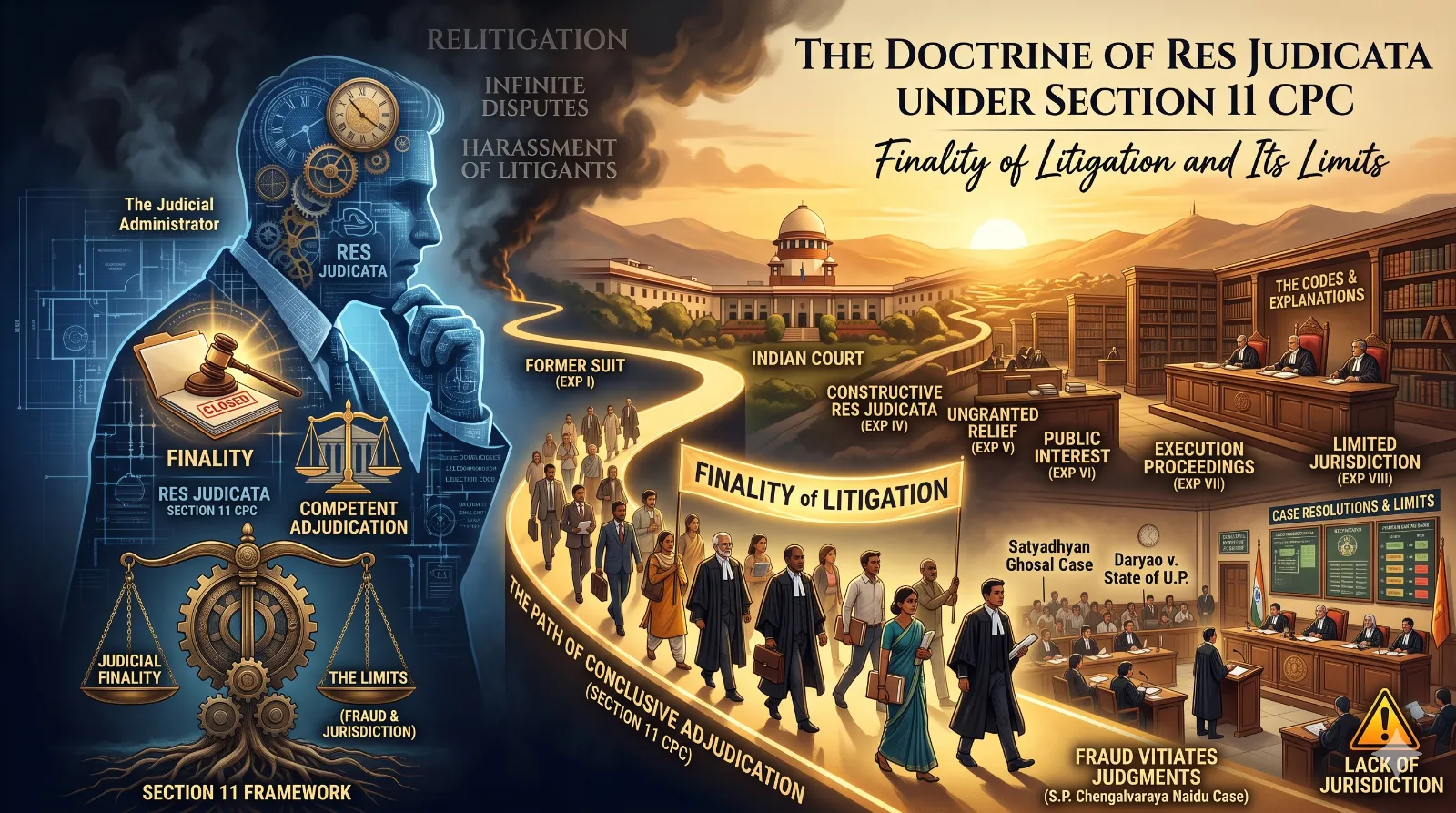
The Doctrine of Res Judicata under Section 11 CPC: Finality of Litigation and Its Limits
Courts exist to resolve disputes, not to keep them alive indefinitely. Section 11 of the Code of Civil Procedure, 1908 (CPC), embodies this principle through the doctrine of res judicata, which prevents parties from reopening matters that have already been finally decided by a competent court. The doctrine protects litigants from repeated proceedings, preserves judicial resources, and gives authority to judicial decisions. However, applying res judicata requires more than establishing that two cases concern similar facts. The nature of the earlier decision, the identity of the parties, the issues adjudicated, and the competence of the court must all be examined. The eight Explanations appended to Section 11 clarify the scope of the doctrine and address situations in which a matter may be treated as already decided, even when it was not expressly determined in the earlier proceedings.
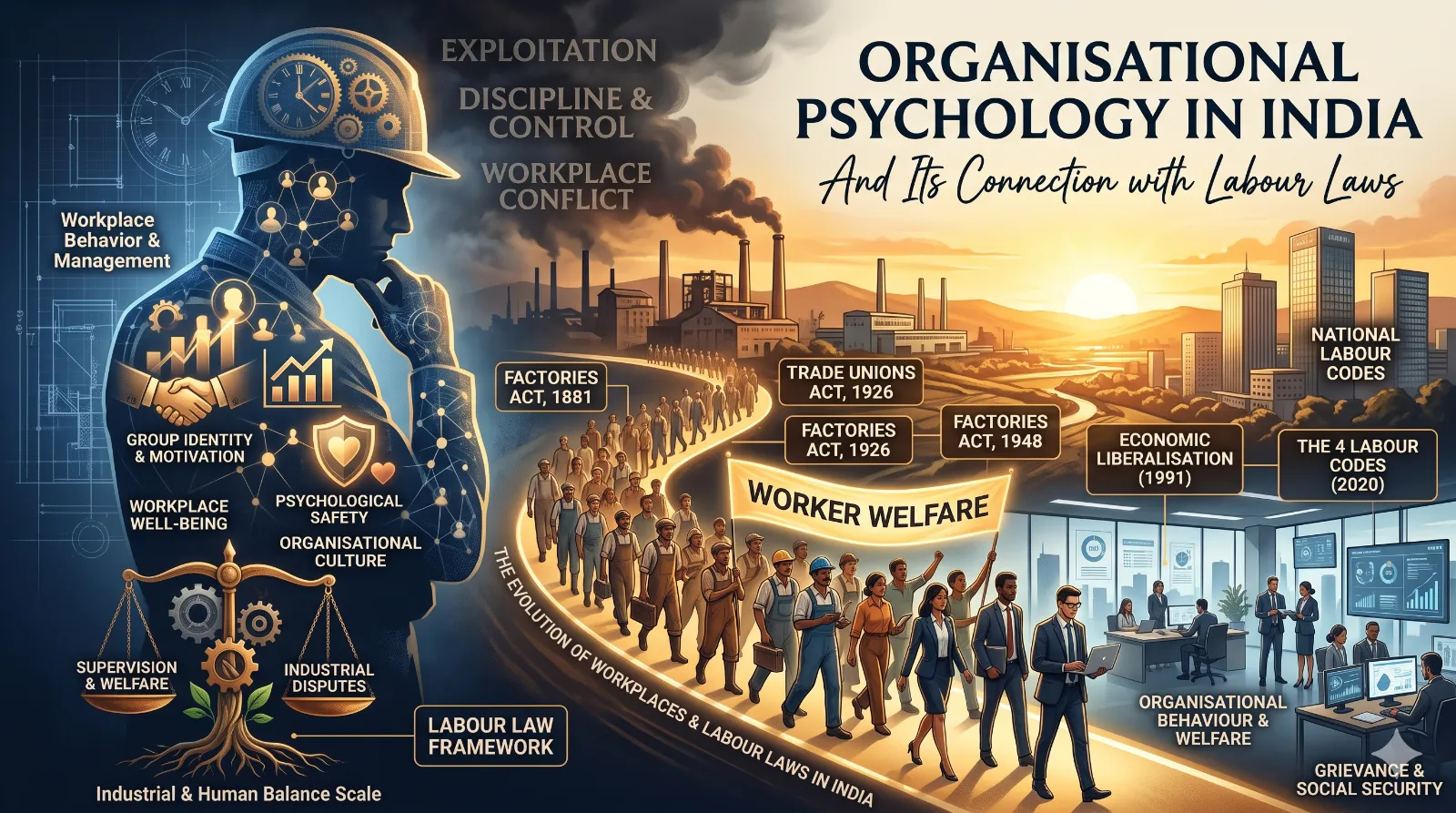
The History of Organisational Psychology in India and Its Connection with Labour Laws
Organisational psychology examines how people behave within organisations, how management influences their performance, and how workplace relationships affect decisionmaking. In India, its development can be understood alongside the country's industrial history, from colonial-era factories to modern corporate workplaces. Although organisational psychology emerged as a distinct discipline largely through Western research, the questions it addresses became increasingly relevant in India as industrial employment expanded and concerns about working conditions, worker representation, and managerial authority grew. The history of Indian labour legislation provides a useful timeline for understanding how the relationship between organisations and the people working within them has changed. From Industrial Control to Human Behaviour 1881–1947: Colonial industrialisation and factory regulation The expansion of factories, railways, mines, and plantations under British rule created a growing need to organise industrial labour. Early management practices emphasised discipline, productivity, and supervision, while workers faced concerns about working hours, safety, and welfare. The Factories Act, 1881, marked an early attempt to regulate factory employment in India. It was followed by further legislation, including the Factories Act, 1948, which developed a broader framework for factory health, safety, and welfare.

Your Success Doesn't Threaten Mine, So Why Does Mine Threaten Yours?
Some people see their friends succeeding and feel inspired. Others see the same success and silently start competing. I have never understood why.