The Doctrine of Res Judicata under Section 11 CPC: Finality of Litigation and Its Limits
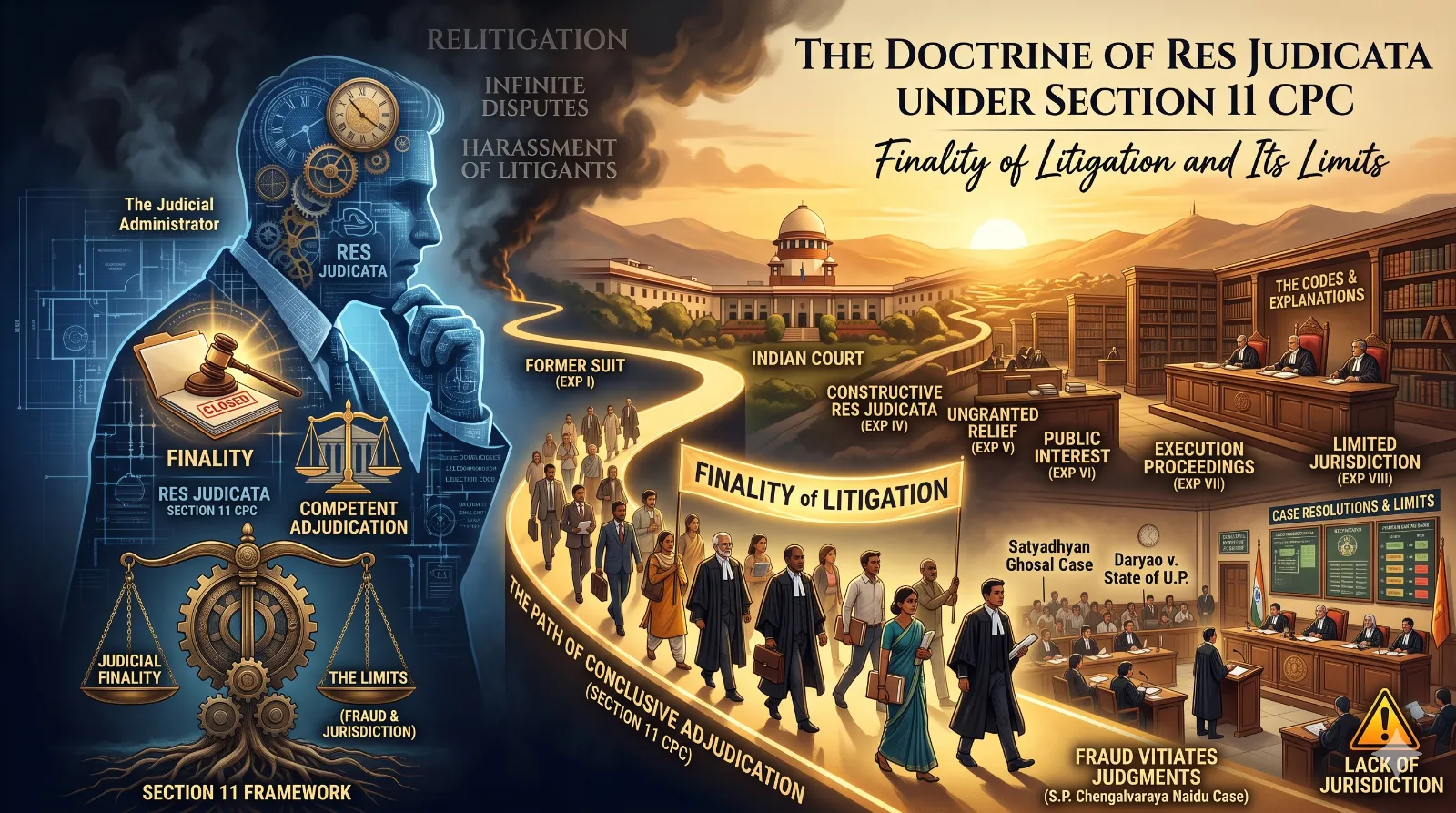
Courts exist to resolve disputes, not to keep them alive indefinitely. Section 11 of the Code of Civil Procedure, 1908 (CPC), embodies this principle through the doctrine of res judicata, which prevents parties from reopening matters that have already been finally decided by a competent court. The doctrine protects litigants from repeated proceedings, preserves judicial resources, and gives authority to judicial decisions. However, applying res judicata requires more than establishing that two cases concern similar facts. The nature of the earlier decision, the identity of the parties, the issues adjudicated, and the competence of the court must all be examined. The eight Explanations appended to Section 11 clarify the scope of the doctrine and address situations in which a matter may be treated as already decided, even when it was not expressly determined in the earlier proceedings.
Courts exist to resolve disputes, not to keep them alive indefinitely. Section 11 of the Code of Civil Procedure, 1908 (CPC), embodies this principle through the doctrine of res judicata, which prevents parties from reopening matters that have already been finally decided by a competent court. The doctrine protects litigants from repeated proceedings, preserves judicial resources, and gives authority to judicial decisions. However, applying res judicata requires more than establishing that two cases concern similar facts. The nature of the earlier decision, the identity of the parties, the issues adjudicated, and the competence of the court must all be examined. The eight Explanations appended to Section 11 clarify the scope of the doctrine and address situations in which a matter may be treated as already decided, even when it was not expressly determined in the earlier proceedings.
Introduction
Courts exist to resolve disputes, not to keep them alive indefinitely. Section 11 of the Code of Civil Procedure, 1908 (CPC), embodies this principle through the doctrine of res judicata, which prevents parties from reopening matters that have already been finally decided by a competent court. The doctrine protects litigants from repeated proceedings, preserves judicial resources, and gives authority to judicial decisions. However, applying res judicata requires more than establishing that two cases concern similar facts. The nature of the earlier decision, the identity of the parties, the issues adjudicated, and the competence of the court must all be examined. The eight Explanations appended to Section 11 clarify the scope of the doctrine and address situations in which a matter may be treated as already decided, even when it was not expressly determined in the earlier proceedings.
The Foundation of Res Judicata
The principle of res judicata rests on the idea that litigation must eventually achieve finality. In Daryao v. State of Uttar Pradesh (1961), the Supreme Court recognised the doctrine as a principle of public policy essential to the orderly administration of justice. Similarly, Satyadhyan Ghosal v. Deorajin Debi (1960) explained that the doctrine can operate at different stages of the same litigation, preventing parties from repeatedly challenging matters already conclusively determined.
Section 11 generally requires that the matter in the subsequent suit must have been directly and substantially in issue in the former suit, between the same parties or persons claiming under them, litigating under the same title. The former court must have been competent in the manner required by the provision, and the matter must have been heard and finally decided. The Explanations to Section 11 are particularly important because they clarify how these requirements operate in different circumstances.
Understanding the Eight Explanations to Section 11 CPC
Explanation I: Meaning of a Former Suit
Explanation I provides that the expression former suit refers to a suit that has been decided before the suit in question, regardless of whether it was instituted before or after the subsequent suit.
The important consideration is therefore the order in which the suits are decided, not necessarily the order in which they were filed. For example, if two related suits are pending and one is decided before the other, the suit decided earlier may qualify as the former suit for applying Section 11, provided the other requirements of the doctrine are satisfied. This prevents the application of res judicata from depending solely on which proceeding was initiated first.
Explanation II: Competence of the Court
Explanation II states that the competence of the court is determined irrespective of any provisions concerning the right of appeal from its decision.
In other words, the question of whether the earlier court was competent to decide the matter is distinct from whether its decision was appealable. The existence or absence of a right of appeal does not, by itself, determine the court's competence for the purposes of Section 11. This Explanation must be read alongside Explanation VIII, which separately addresses decisions by courts of limited jurisdiction.
Explanation III: The Matter Must Have Been Raised and Contested
Explanation III provides that the matter must have been alleged by one party and either denied or admitted, expressly or impliedly, by the other.
This requirement helps identify whether an issue genuinely formed part of the earlier dispute. A matter cannot ordinarily be treated as directly and substantially in issue merely because it appeared in the background of the case. The pleadings and the parties' responses help establish whether the matter was actually placed before the court for determination.
The Explanation therefore assists courts in distinguishing between issues that were genuinely contested or admitted and matters that were merely incidental to the earlier proceedings.
Explanation IV: Constructive Res Judicata
Explanation IV introduces the doctrine of constructive res judicata. It provides that a matter which might and ought to have been made a ground of attack or defence in the former suit shall be deemed to have been directly and substantially in issue in that suit.
This rule prevents parties from deliberately withholding arguments and introducing them through subsequent litigation. A litigant cannot ordinarily divide a case into separate proceedings by raising one ground initially and reserving another ground that should have been raised at the same time.
In Forward Construction Co. v. Prabhat Mandal (1986), the Supreme Court considered constructive res judicata and its application in the context of public interest litigation. The decision illustrates the broader purpose of the doctrine: parties should not be permitted to reopen settled controversies through grounds that ought to have been presented earlier. Constructive res judicata is not a rule that every unraised argument is automatically barred. The statutory requirement that the matter might and ought to have been raised must be satisfied.
Explanation V: Relief Claimed but Not Expressly Granted
Explanation V provides that any relief claimed in the plaint which is not expressly granted by the decree shall, for the purposes of Section 11, be deemed to have been refused. For instance, suppose a plaintiff seeks both a declaration of ownership and a permanent injunction in a suit. If the decree grants the declaration but does not expressly grant the injunction, the relief not expressly granted is deemed to have been refused under this Explanation.
The rule prevents a party from treating an ungranted relief as though it remains automatically available for a fresh claim. Its application must, however, be understood in the context of the earlier pleadings, decree, and other requirements of res judicata.
Explanation VI: Litigation Concerning Public or Common Rights
Explanation VI addresses cases in which persons litigate bona fide in respect of a public right or a private right claimed in common for themselves and others. Where the statutory conditions are satisfied, persons interested in that right may be deemed to claim under the persons who conducted the earlier litigation.
This Explanation is particularly relevant where a proceeding concerns a right shared by a wider group rather than an exclusively individual interest. It helps prevent repeated litigation over the same common right merely because different interested persons bring successive proceedings. However, the earlier litigation must have been conducted bona fide, and the other requirements of the Explanation must be satisfied. It does not mean that every public interest litigation automatically bars subsequent proceedings concerning the same subject.
In Daryao v. State of Uttar Pradesh, the Supreme Court also recognised the application of res judicata to writ proceedings. The judgment demonstrates that constitutional remedies are not entirely outside the principle of finality, although the nature of the proceedings and the applicable legal requirements remain important.
Explanation VII: Application to Execution Proceedings
Explanation VII expressly extends the provisions of Section 11 to execution proceedings. For this purpose, references in the section to a suit, issue, former suit, and subsequent suit are to be understood in their corresponding execution-related sense.
Execution proceedings concern the enforcement of a decree. They are not ordinarily an opportunity to reopen the original dispute or repeatedly challenge questions that have already been conclusively determined during execution.
In Satyadhyan Ghosal v. Deorajin Debi, the Supreme Court discussed the operation of res judicata at successive stages of litigation. Explanation VII makes the application of the doctrine to execution proceedings explicit, subject to the requirements of the provision.
Explanation VIII: Decisions by Courts of Limited Jurisdiction
Explanation VIII provides that an issue heard and finally decided by a court of limited jurisdiction, which was competent to decide that issue, operates as res judicata in a subsequent suit, even if that court was not competent to try the subsequent suit as a whole. This is an important qualification to the general requirement concerning the competence of the former court. A court may lack jurisdiction to entertain an entire suit but still possess the authority to decide a particular issue arising before it. If that issue is heard and finally decided within its competence, the decision may bind the parties in later proceedings. The Explanation prevents parties from reopening an issue merely because the earlier court could not have tried the entire subsequent suit.
The Limits of Res Judicata
Although Section 11 protects the finality of judicial decisions, it does not make every earlier judgment immune from challenge. The doctrine depends on the legal validity of the earlier adjudication and the fulfilment of the statutory requirements.
In S.P. Chengalvaraya Naidu v. Jagannath (1994), the Supreme Court strongly condemned the use of fraud to obtain a judicial decision. A judgment obtained by fraud on the court cannot be protected merely because it has formally been pronounced. Fraud undermines the integrity of the judicial process and may deprive the resulting judgment of its legitimate effect. Jurisdiction also remains fundamental. Section 11 requires the relevant competence of the earlier court, while Explanation VIII specifically deals with courts of limited jurisdiction. An objection to jurisdiction must therefore be examined according to the applicable statutory rules and the nature of the earlier court's authority.
Nor does res judicata necessarily prevent proceedings concerning genuinely new causes of action or fresh circumstances. Where a continuing obligation gives rise to a new dispute, the legal position may differ from a case that merely seeks to reopen an issue already decided. The distinction depends on the facts and the applicable law.
Conclusion
Section 11 CPC establishes a framework for ensuring that disputes, once properly adjudicated, do not remain indefinitely open to litigation. Its eight Explanations give practical meaning to the doctrine by clarifying what constitutes a former suit, how issues are identified, when unraised grounds are barred, how ungranted relief is treated, and how res judicata operates in public rights litigation, execution proceedings, and matters decided by courts of limited jurisdiction.
The decisions in Daryao, Satyadhyan Ghosal, Forward Construction, and S.P. Chengalvaraya Naidu demonstrate the importance of balancing finality with the requirements of justice. Res judicata protects parties from repeated litigation and preserves the authority of judicial decisions, but it must be applied within the boundaries established by law.
Ultimately, the doctrine ensures that litigation has a meaningful end without treating finality as an excuse to preserve a judgment that the law cannot legitimately recognise as conclusive.
Comments
You may also like

The History of Organisational Psychology in India and Its Connection with Labour Laws
Organisational psychology examines how people behave within organisations, how management influences their performance, and how workplace relationships affect decisionmaking. In India, its development can be understood alongside the country's industrial history, from colonial-era factories to modern corporate workplaces. Although organisational psychology emerged as a distinct discipline largely through Western research, the questions it addresses became increasingly relevant in India as industrial employment expanded and concerns about working conditions, worker representation, and managerial authority grew. The history of Indian labour legislation provides a useful timeline for understanding how the relationship between organisations and the people working within them has changed. From Industrial Control to Human Behaviour 1881–1947: Colonial industrialisation and factory regulation The expansion of factories, railways, mines, and plantations under British rule created a growing need to organise industrial labour. Early management practices emphasised discipline, productivity, and supervision, while workers faced concerns about working hours, safety, and welfare. The Factories Act, 1881, marked an early attempt to regulate factory employment in India. It was followed by further legislation, including the Factories Act, 1948, which developed a broader framework for factory health, safety, and welfare.
Is a Company a Citizen or a National? Understanding the Position Under Indian Law
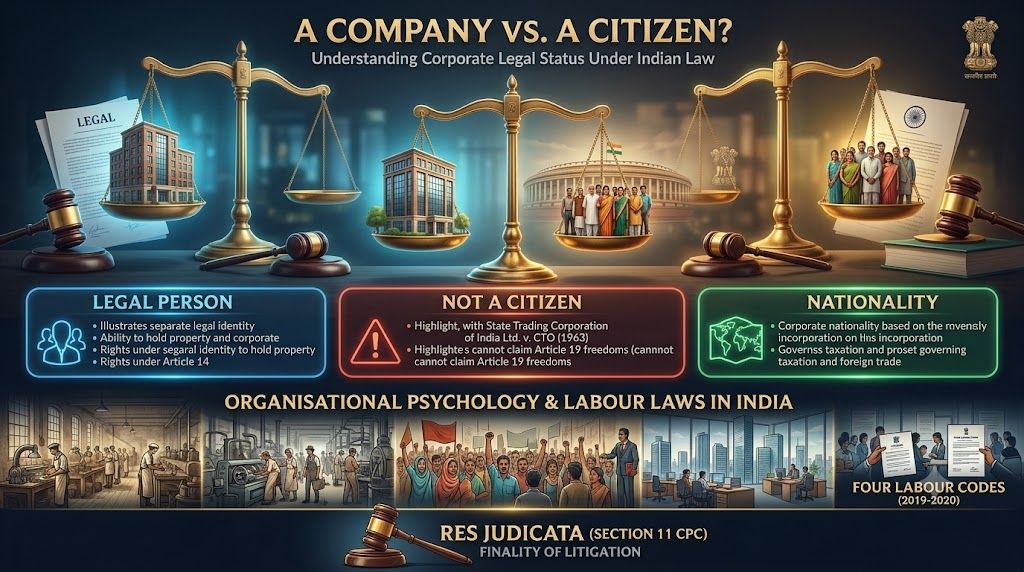
Can a company incorporated in India claim the same constitutional status as an Indian citizen? At first glance, the answer might appear obvious. A company may be established under Indian law, conduct business within the country, employ Indian citizens, and contribute significantly to the national economy. Yet, despite its distinct legal identity, a company does not enjoy every right available to an individual. This distinction came into sharp focus before the Supreme Court of India in State Trading Corporation of India Ltd. v. Commercial Tax Officer, AIR 1963 SC 1811, a landmark judgment that clarified the constitutional position of companies and established an important distinction between legal personality, citizenship, and corporate nationality.

Your Success Doesn't Threaten Mine, So Why Does Mine Threaten Yours?
Some people see their friends succeeding and feel inspired. Others see the same success and silently start competing. I have never understood why.