When Leadership Becomes Self-Blame: The Hidden Cost of Irresponsibility in a Team
Not every failure within a team is a failure of leadership. Sometimes, the expectations are clear, the responsibilities are understood, and the only thing missing is the willingness to act.

Not every failure within a team is a failure of leadership. Sometimes, the expectations are clear, the responsibilities are understood, and the only thing missing is the willingness to act.
Not every failure within a team is a failure of leadership. Sometimes, the expectations are clear, the responsibilities are understood, and the only thing missing is the willingness to act.
Leadership is often described as the ability to guide, motivate, communicate, and bring people together towards a common objective. We are repeatedly told that when a team fails, the leader must take responsibility.
But there is a question that rarely receives the attention it deserves:
What happens when a leader takes responsibility for people who refuse to take responsibility for themselves?
In every organisation, there are individuals who genuinely require guidance. They may struggle with instructions, lack experience, or need additional support to perform their responsibilities effectively. A good leader recognises these difficulties and makes an effort to address them.
However, there is another category of behaviour that is far more difficult to manage.
There are individuals who understand their responsibilities, are aware of deadlines, know what is expected of them, and have received the necessary instructions. Yet, when the time comes to deliver, they behave as though nothing was ever communicated.
The same instructions must be repeated. The same expectations must be explained. The same deadlines must be followed up on.
And gradually, the responsibility for completing the work shifts from the person assigned to perform it to the person responsible for supervising it.
When Understanding Is Not the Problem
One of the most exhausting experiences in leadership is repeatedly explaining something that has already been understood.
A leader begins by questioning their communication.
Perhaps I was not clear enough.
Perhaps I should have explained the process differently.
Perhaps I expected too much.
Perhaps I failed to provide the right guidance.
These questions are reasonable. In fact, the willingness to examine one's own shortcomings is an important quality of effective leadership.
But self-reflection becomes unhealthy when it turns into automatic self-blame.
There is a significant difference between an employee who does not understand what needs to be done and an employee who understands but does not act.
The first situation requires guidance.
The second requires accountability.
And when leaders fail to recognise this distinction, they may spend their time improving explanations while the actual problem remains unchanged.
The Invisible Transfer of Responsibility
Irresponsibility does not always appear as open refusal.
Sometimes, it appears through repeated delays, selective confusion, incomplete work, avoidable mistakes, or the constant need for reminders.
An employee may never explicitly say, "I will not do this."
Instead, their behaviour gradually creates a situation in which someone else must intervene to ensure the task is completed.
The leader follows up, checks progress, repeats instructions, corrects mistakes, and eventually takes responsibility for the outcome.
Over time, an unhealthy pattern develops.
The employee becomes dependent on supervision, while the leader becomes responsible for both supervision and execution.
This creates an imbalance that is rarely visible in organisational charts.
On paper, responsibilities are distributed.
In practice, accountability is concentrated in one person.
And the more conscientious that person is, the more likely they are to compensate for the shortcomings of others.
The Psychological Cost of Being a Responsible Leader
A responsible leader does not simply think about whether the work has been completed.
They think about why it has not been completed.
They question whether their expectations were realistic, whether their communication was effective, and whether they could have done something differently.
This ability to reflect is valuable. But when every failure becomes an opportunity for self-criticism, leadership begins to carry an unnecessary psychological burden.
The leader starts questioning their competence, even when the actual issue lies in another person's failure to fulfil an agreed responsibility.
What makes this particularly difficult is that the people who care most about outcomes are often the ones who experience the greatest frustration when those outcomes are not achieved.
Meanwhile, individuals who repeatedly avoid ownership may experience comparatively little pressure because someone else continues to absorb the consequences.
The person who cares the most begins carrying the burden created by the person who contributes the least.
That is not sustainable teamwork.
It is an unequal distribution of responsibility.
Accountability Is Not the Opposite of Empathy
There is a common misunderstanding that being an understanding leader means continuously accommodating the shortcomings of others.
But empathy does not require the absence of accountability.
A leader can recognise personal difficulties, provide flexibility, offer guidance, and still expect professional responsibilities to be fulfilled.
Understanding why someone struggles is different from repeatedly accepting avoidable non-performance.
Similarly, holding someone accountable does not mean humiliating them, questioning their character, or refusing to acknowledge genuine difficulties.
It means recognising that professional commitments carry obligations.
If responsibilities have been communicated, resources have been provided, and expectations have been mutually understood, then the individual performing the work must also accept responsibility for the outcome.
Leadership cannot become a permanent substitute for personal discipline.
When Self-Reflection Becomes Self-Doubt
Perhaps the most troubling consequence of repeated irresponsibility is not the unfinished work itself.
It is the gradual change in how a leader perceives their own abilities.
A person who once made decisions confidently begins reconsidering even the simplest instructions.
They become excessively cautious about delegating responsibilities. They start monitoring every minor task. They feel compelled to remain constantly available because they no longer trust that work will progress without their intervention.
Eventually, they may begin to believe that their inability to make everyone perform consistently reflects a personal failure.
But leadership does not provide control over another person's intentions, discipline, or willingness to contribute.
A leader can establish expectations, create systems, provide resources, communicate effectively, and address obstacles.
What they cannot do is manufacture a sense of responsibility in someone who repeatedly chooses not to exercise it.
And perhaps this is one of the most difficult lessons in leadership:
You can be responsible for creating the conditions in which people can perform, without being personally responsible for every decision they make within those conditions.
The Difference Between Supporting a Team and Carrying It
A healthy team is built on mutual responsibility.
Leaders provide direction, clarity, and support. Team members contribute through ownership, communication, and execution.
When this relationship functions properly, leadership enables people to become more capable and independent.
But when a leader must continuously remind, explain, supervise, and rescue the same responsibilities, support can gradually turn into dependency.
The organisation may continue functioning, but its functioning depends increasingly on the effort of a few individuals rather than the collective contribution of the team.
This is where leaders must begin asking a different question.
Instead of repeatedly asking, "What more could I have done to make them understand?"
Perhaps they should ask:
"Have I created an environment where people understand their responsibilities but have learned that someone else will ultimately carry the consequences of not fulfilling them?"
That question is uncomfortable because it shifts the discussion from communication alone to the culture of accountability.
A Leader Is Responsible for Direction, Not Every Individual Choice
None of this means leaders should be exempt from criticism.
Poor communication, unrealistic deadlines, inadequate resources, inconsistent expectations, and ineffective management can all contribute to poor performance.
A leader must remain willing to examine these possibilities.
But accountability must work in both directions.
Employees cannot be treated as independent professionals when receiving responsibilities and as individuals without agency when those responsibilities remain unfulfilled.
If someone has the knowledge, resources, authority, and reasonable opportunity to perform a task, their decisions must also be part of the evaluation.
Otherwise, leadership becomes an arrangement in which one person is accountable for everyone's actions while others remain accountable only when convenient.
That is neither fair nor effective.
Final Reflection: Leadership Should Not Require Losing Yourself
There is a point at which a leader must recognise that continuously blaming themselves is not always a sign of maturity.
Sometimes, it is a sign that they have accepted responsibility beyond what reasonably belongs to them.
A strong leader should be capable of admitting mistakes, improving communication, and supporting people through genuine difficulties.
But strength also involves recognising when the problem is no longer a lack of guidance.
Not every delay is a misunderstanding.
Not every incomplete task reflects poor leadership.
Not every repeated mistake can be solved through another explanation.
And not every person who knows what to do is equally willing to do it.
Leadership requires accountability, but accountability cannot remain a one-person responsibility.
Because the purpose of building a team is not to create more people whose responsibilities a leader must carry.
It is to create a group of individuals who understand that their contribution matters, their commitments have consequences, and their responsibilities belong to them.
A leader can guide a team, but a team must also be willing to lead itself through ownership of its work.
And sometimes, the most important lesson a leader must learn is that accepting responsibility for everything is not the same as being responsible.
Comments
You may also like
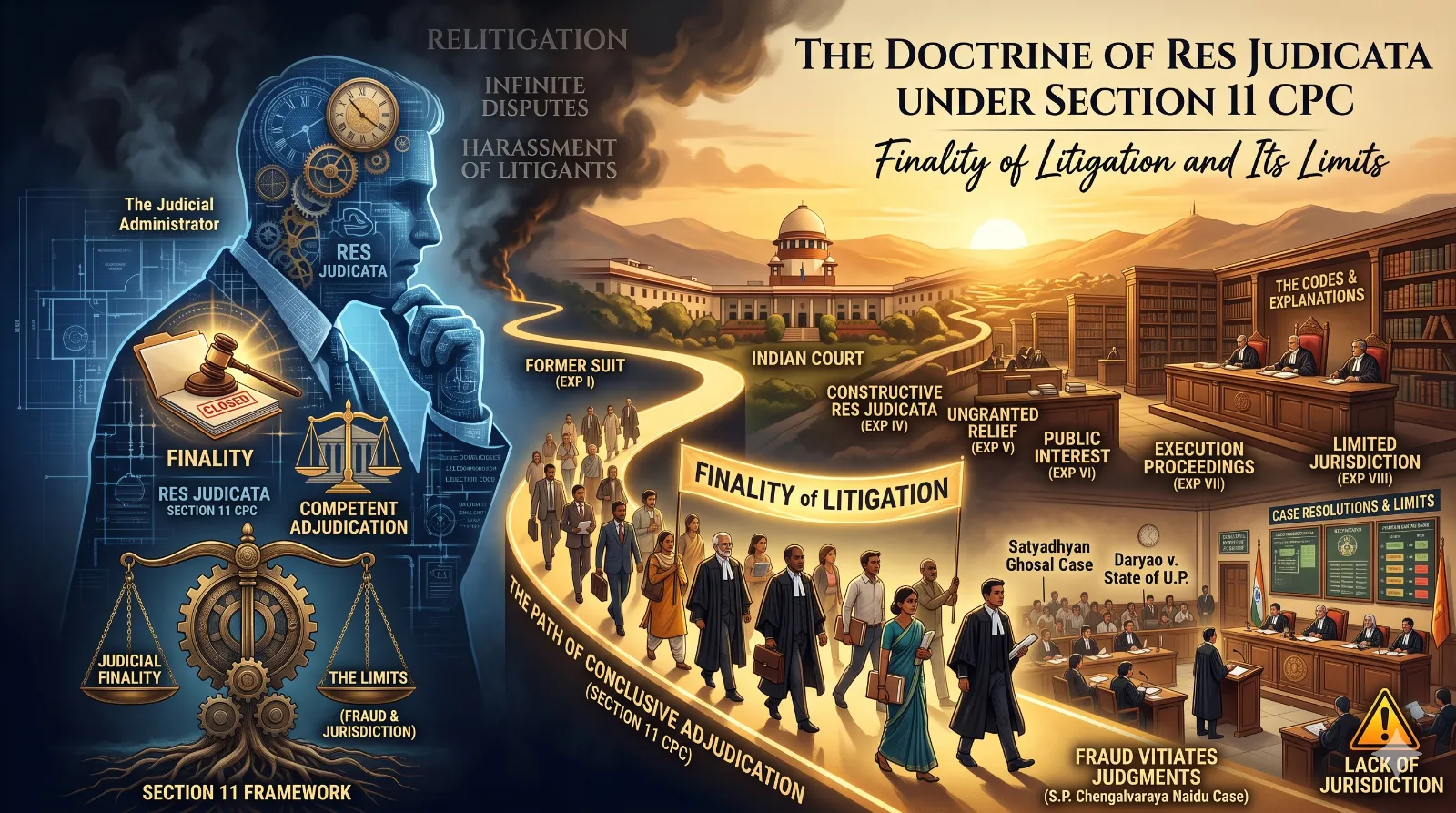
The Doctrine of Res Judicata under Section 11 CPC: Finality of Litigation and Its Limits
Courts exist to resolve disputes, not to keep them alive indefinitely. Section 11 of the Code of Civil Procedure, 1908 (CPC), embodies this principle through the doctrine of res judicata, which prevents parties from reopening matters that have already been finally decided by a competent court. The doctrine protects litigants from repeated proceedings, preserves judicial resources, and gives authority to judicial decisions. However, applying res judicata requires more than establishing that two cases concern similar facts. The nature of the earlier decision, the identity of the parties, the issues adjudicated, and the competence of the court must all be examined. The eight Explanations appended to Section 11 clarify the scope of the doctrine and address situations in which a matter may be treated as already decided, even when it was not expressly determined in the earlier proceedings.
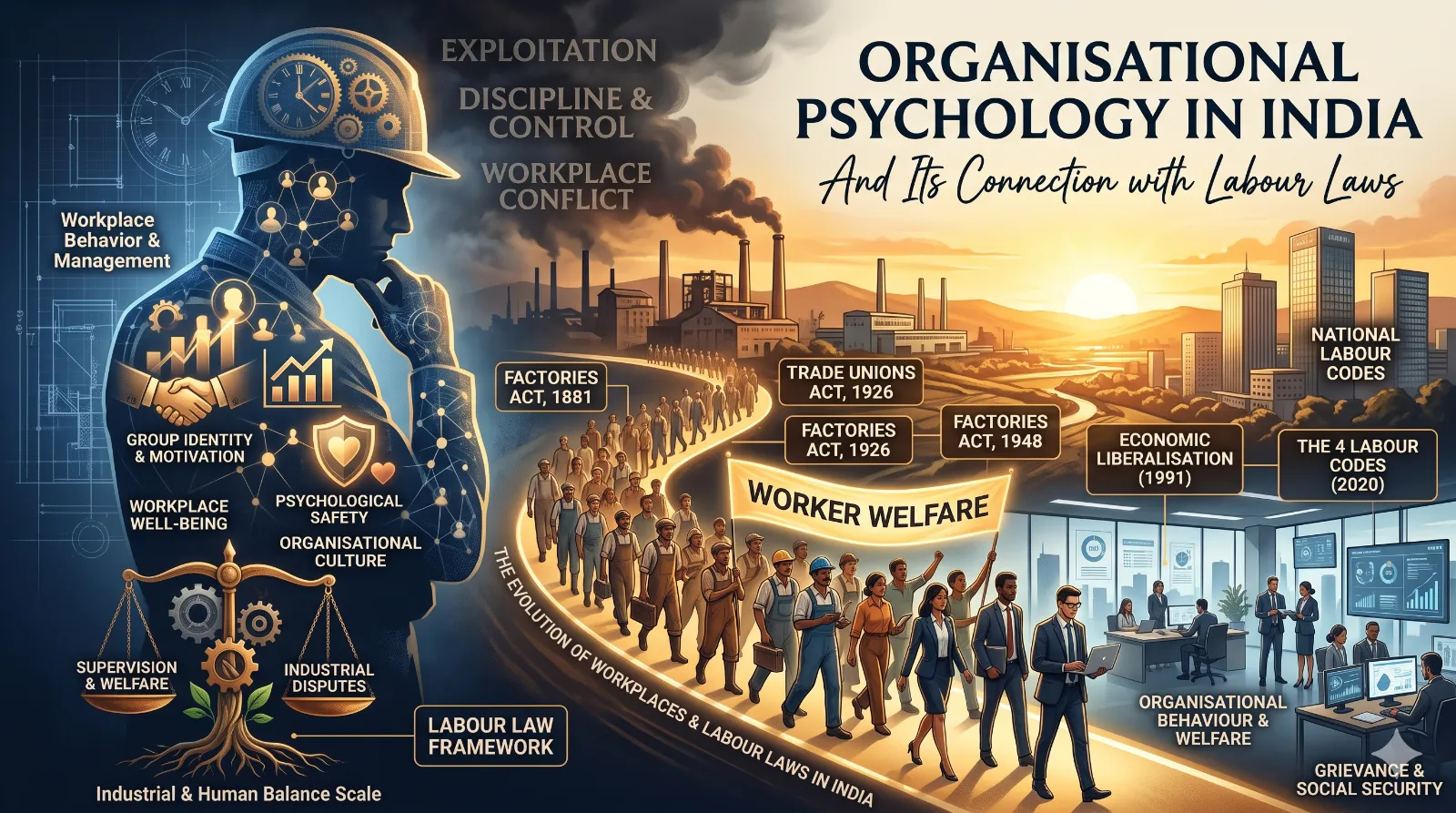
The History of Organisational Psychology in India and Its Connection with Labour Laws
Organisational psychology examines how people behave within organisations, how management influences their performance, and how workplace relationships affect decisionmaking. In India, its development can be understood alongside the country's industrial history, from colonial-era factories to modern corporate workplaces. Although organisational psychology emerged as a distinct discipline largely through Western research, the questions it addresses became increasingly relevant in India as industrial employment expanded and concerns about working conditions, worker representation, and managerial authority grew. The history of Indian labour legislation provides a useful timeline for understanding how the relationship between organisations and the people working within them has changed. From Industrial Control to Human Behaviour 1881–1947: Colonial industrialisation and factory regulation The expansion of factories, railways, mines, and plantations under British rule created a growing need to organise industrial labour. Early management practices emphasised discipline, productivity, and supervision, while workers faced concerns about working hours, safety, and welfare. The Factories Act, 1881, marked an early attempt to regulate factory employment in India. It was followed by further legislation, including the Factories Act, 1948, which developed a broader framework for factory health, safety, and welfare.
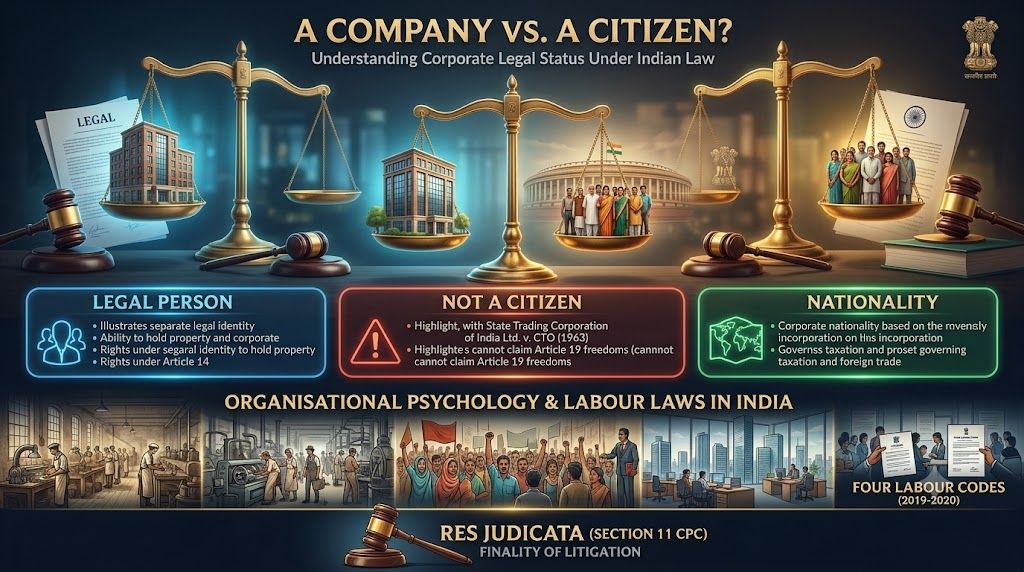
Is a Company a Citizen or a National? Understanding the Position Under Indian Law
Can a company incorporated in India claim the same constitutional status as an Indian citizen? At first glance, the answer might appear obvious. A company may be established under Indian law, conduct business within the country, employ Indian citizens, and contribute significantly to the national economy. Yet, despite its distinct legal identity, a company does not enjoy every right available to an individual. This distinction came into sharp focus before the Supreme Court of India in State Trading Corporation of India Ltd. v. Commercial Tax Officer, AIR 1963 SC 1811, a landmark judgment that clarified the constitutional position of companies and established an important distinction between legal personality, citizenship, and corporate nationality.