
—
—
A cigarette may last for a few minutes. The assumptions attached to the woman holding it can last much longer.
Imagine a crowded café.
Outside, two people are smoking. One is a man. One is a woman.
Someone might look at the man and think, “He smokes.” But when their eyes move towards the woman, the thought sometimes becomes something much bigger: What kind of girl is she? Her parents probably do not know. She must be very modern. She looks rebellious. Would I want someone like her in my family?
And somewhere between the cigarette and the smoke, society has somehow produced an entire character certificate for a person it knows absolutely nothing about.
That is what makes this conversation interesting. Because this is not really a discussion about smoking. It is a discussion about why women’s ordinary choices are so often treated as evidence of their character.
The Cigarette Is the Same. Is the Judgment?
Smoking is harmful to health. That fact does not change depending upon whether the person holding the cigarette is a man or a woman.
And yet social responses can be very different. Research examining women’s experiences of smoking stigma has found that women can experience gender-specific forms of judgment connected not only with smoking itself but also with ideas about femininity, motherhood, social class and respectability. A systematic review of 23 studies found that women’s experiences of smoking stigma were influenced by factors including cultural background, social class and motherhood.
That distinction matters. There is a difference between saying, “Smoking is unhealthy,” and saying, “A woman who smokes must have bad character.” The first statement concerns a behaviour and its health consequences. The second attempts to construct an individual’s entire personality and morality from that behaviour.
And somehow, society is remarkably comfortable making that jump when the smoker is a woman.
When a Habit Becomes a Character Test
Think about the language we use.
When a man smokes outside an office after a stressful meeting, people may describe him as stressed, addicted or simply someone who smokes. A woman doing exactly the same thing can sometimes be described using completely different vocabulary: too bold, not from a good family, attention seeking, not decent, not marriage material, or trying to behave like a man.
Suddenly, the conversation is no longer about nicotine. It is about womanhood.
Recent research on gendered perceptions of smoking describes this pattern: women’s smoking can be interpreted as violating expectations surrounding femininity and socially acceptable behaviour, while men’s smoking is comparatively more normalised in many settings.
Which raises an uncomfortable question: Why do we need to know whether a woman is “good” before allowing her to simply exist in a public space?
The Invisible Idea of the “Good Woman”
Every society develops expectations about what a respectable woman should look like. She should speak a certain way. Dress within certain boundaries. Return home at an acceptable hour. Drink within acceptable limits—or preferably not at all. Express sexuality carefully. Control anger. Avoid appearing “too independent.” And in many social environments, smoking gets added to this invisible list.
The interesting thing is that these rules are rarely written anywhere. No one hands a girl a document titled “Terms and Conditions for Being Considered a Respectable Woman.” Yet women learn these rules remarkably early.
Through comments. Through relatives. Through films. Through neighbours. Through whispers at family gatherings. Through the seemingly harmless sentence: “Log kya kahenge?”
And consequently, something as small as holding a cigarette can become symbolic. It may be interpreted as independence, rebellion, westernisation, sexual freedom, carelessness, or resistance to traditional femininity.
The cigarette has not revealed any of these things. The observer has supplied them.
The Indian Context Makes the Question Even More Interesting
India cannot be treated as one homogeneous society. Attitudes towards tobacco differ dramatically across regions, communities, socioeconomic groups and forms of tobacco consumption. Research reviewing tobacco culture in India notes that women’s tobacco use does not carry identical meanings everywhere; in some rural and tribal communities, certain forms of tobacco use by women have historically been considerably more socially accepted than cigarette smoking by women in urban environments.
Even within cities, context changes everything. A woman smoking outside a corporate office in Gurugram may receive one reaction. The same woman smoking outside her family home in a smaller town may receive another. A woman smoking at a private party may be ignored. The same woman smoking alone beside a roadside tea stall may attract repeated glances.
So perhaps we are not simply judging smoking. We are judging where a woman is, whom she is with, how she is dressed, what time it is and whether we think she belongs in that space. The cigarette merely makes her visible.
Freedom Can Also Become Part of the Symbolism
A qualitative study involving women smokers in Pune found that participants described several reasons for beginning or continuing smoking, including curiosity, experimentation, peer groups, work environments and stress. Some participants also associated smoking with feelings of liberation and independence.
That does not mean smoking equals empowerment. It certainly does not make cigarettes healthy. But it tells us something important about symbolism.
For generations, certain public behaviours were predominantly associated with men: smoking, drinking, sitting alone at roadside establishments, remaining outside late at night, travelling alone, and occupying public spaces without explaining why. When women began entering these spaces, society did not always interpret their behaviour neutrally. Sometimes the woman herself became the spectacle.
And Then Comes the Question of “Character”
Perhaps the strangest assumption is that smoking tells us anything meaningful about someone’s moral character.
Can a cigarette tell us whether someone is kind? Whether she is loyal? Whether she respects her parents? Whether she works hard? Whether she treats people well? Whether she is trustworthy? Whether she will be a good partner? Whether she is intelligent? Obviously not.
You may reasonably decide that you do not want to smoke. You may dislike cigarette smoke. You may refuse to date someone who smokes. You may worry about the health of someone you care about. All of those are personal boundaries.
But there is a considerable distance between “I dislike this habit” and “Therefore, she is a bad woman.” That distance is where prejudice often lives.
Would We React the Same Way If She Were a Man?
Perhaps the easiest way to examine our own conditioning is through a small mental experiment.
The next time you see a woman smoking in public and immediately form an opinion, mentally replace her with a man. Would you still make the same assumption?
If you thought, “She must be irresponsible,” would you automatically think the same about him? If you wondered, “What must her parents think?” would his parents even enter your mind? If you thought, “She does not look like a decent girl,” would you use the word decency while observing a male smoker?
If the answer changes according to gender, perhaps the cigarette was never the real issue.
This Isn’t About Defending Smoking
Conversations about gender sometimes become unnecessarily binary. Questioning the judgment faced by women who smoke does not require us to glorify smoking.
Smoking remains a serious public-health concern. We can discourage tobacco consumption without humiliating tobacco users. We can discuss addiction without attaching morality to it. And we can criticise an unhealthy behaviour without deciding that the person engaging in it lacks character.
Both ideas can exist simultaneously: smoking can be unhealthy, and sexist judgment can also be unhealthy for society.
Maybe the Better Question Is About Us
When we see someone for five seconds in a public place, we possess almost no meaningful information about that person’s life. Yet humans are extraordinarily quick at constructing stories. And women, particularly women who behave outside conventional expectations, frequently become the subjects of those stories.
So perhaps the next time we see a woman standing somewhere with a cigarette between her fingers, the most interesting question is not, “What kind of woman is she?” Maybe it is, “Why did I think I could determine what kind of woman she is from that?”
Because sometimes the assumptions we make about another person’s character reveal considerably more about our conditioning than they reveal about hers.
Think About It
Two strangers are standing in the same place. Both are smoking the same cigarette. One is a man. One is a woman. What changes in your mind when you look from one to the other?
That answer may be worth examining.
Comments
You may also like

The Doctrine of Res Judicata under Section 11 CPC: Finality of Litigation and Its Limits
Courts exist to resolve disputes, not to keep them alive indefinitely. Section 11 of the Code of Civil Procedure, 1908 (CPC), embodies this principle through the doctrine of res judicata, which prevents parties from reopening matters that have already been finally decided by a competent court. The doctrine protects litigants from repeated proceedings, preserves judicial resources, and gives authority to judicial decisions. However, applying res judicata requires more than establishing that two cases concern similar facts. The nature of the earlier decision, the identity of the parties, the issues adjudicated, and the competence of the court must all be examined. The eight Explanations appended to Section 11 clarify the scope of the doctrine and address situations in which a matter may be treated as already decided, even when it was not expressly determined in the earlier proceedings.
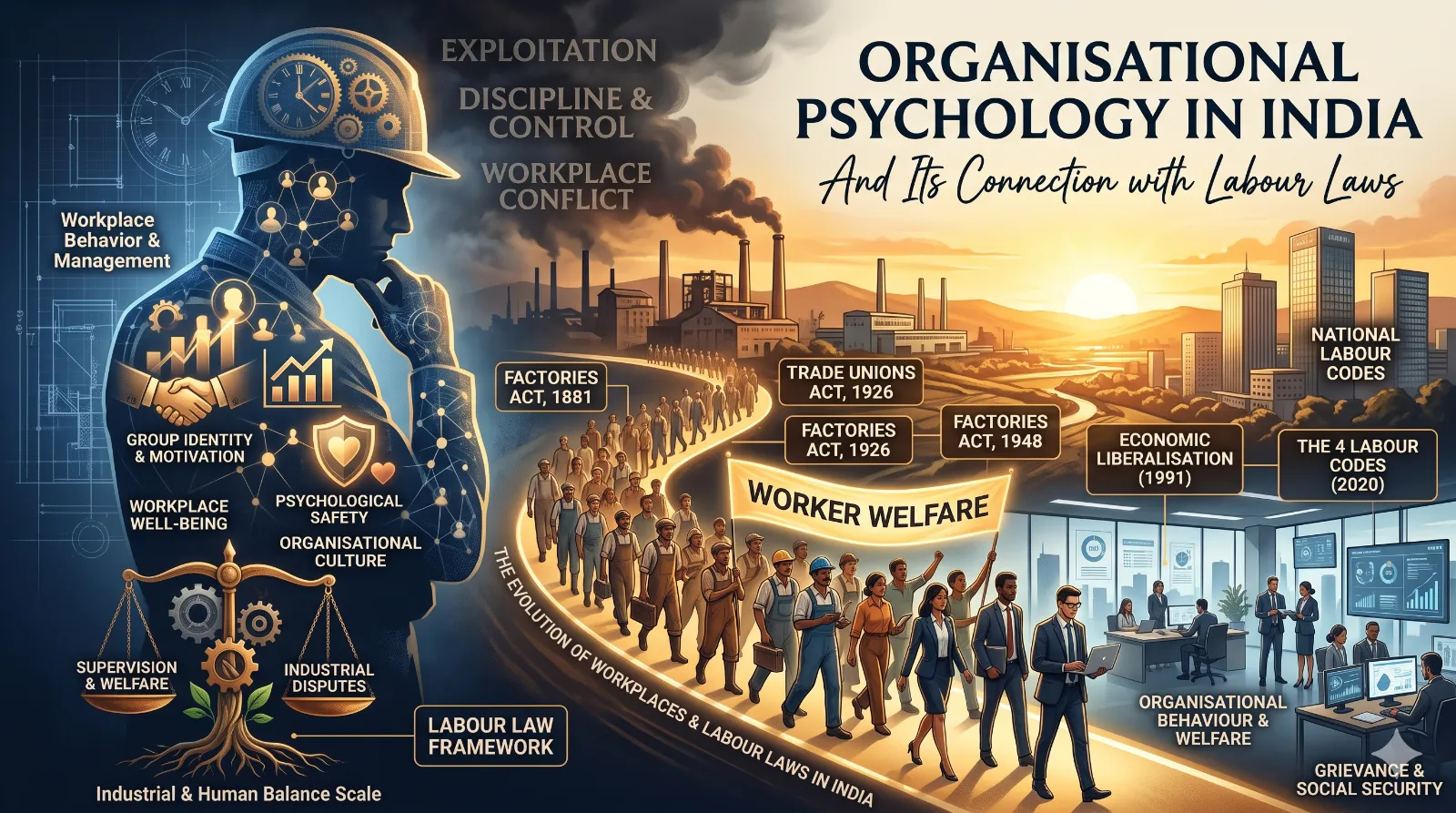
The History of Organisational Psychology in India and Its Connection with Labour Laws
Organisational psychology examines how people behave within organisations, how management influences their performance, and how workplace relationships affect decisionmaking. In India, its development can be understood alongside the country's industrial history, from colonial-era factories to modern corporate workplaces. Although organisational psychology emerged as a distinct discipline largely through Western research, the questions it addresses became increasingly relevant in India as industrial employment expanded and concerns about working conditions, worker representation, and managerial authority grew. The history of Indian labour legislation provides a useful timeline for understanding how the relationship between organisations and the people working within them has changed. From Industrial Control to Human Behaviour 1881–1947: Colonial industrialisation and factory regulation The expansion of factories, railways, mines, and plantations under British rule created a growing need to organise industrial labour. Early management practices emphasised discipline, productivity, and supervision, while workers faced concerns about working hours, safety, and welfare. The Factories Act, 1881, marked an early attempt to regulate factory employment in India. It was followed by further legislation, including the Factories Act, 1948, which developed a broader framework for factory health, safety, and welfare.
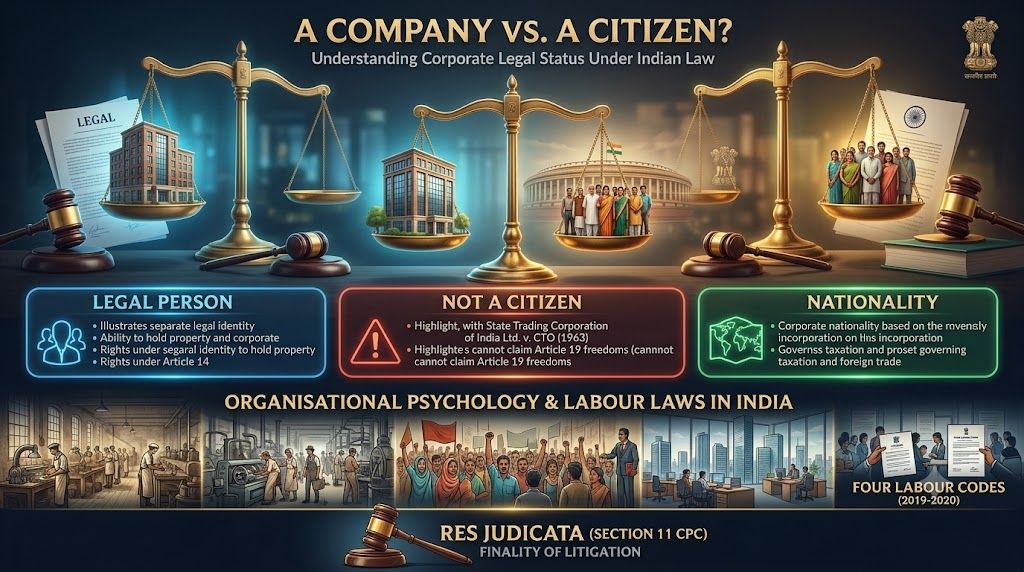
Is a Company a Citizen or a National? Understanding the Position Under Indian Law
Can a company incorporated in India claim the same constitutional status as an Indian citizen? At first glance, the answer might appear obvious. A company may be established under Indian law, conduct business within the country, employ Indian citizens, and contribute significantly to the national economy. Yet, despite its distinct legal identity, a company does not enjoy every right available to an individual. This distinction came into sharp focus before the Supreme Court of India in State Trading Corporation of India Ltd. v. Commercial Tax Officer, AIR 1963 SC 1811, a landmark judgment that clarified the constitutional position of companies and established an important distinction between legal personality, citizenship, and corporate nationality.