Legal Rights of Couples in Live-in Relationships in India: A Study of Laws and Court Decisions
Relationships between people who live together, or 'love marriage' have become a common sight in India but are not legally recognized as marriage. There is no one national code in Indian Law that provides full spousal rights to unmarried cohabitants. Rather, the rights of couples

Relationships between people who live together, or 'love marriage' have become a common sight in India but are not legally recognized as marriage. There is no one national code in Indian Law that provides full spousal rights to unmarried cohabitants. Rather, the rights of couples
Abstract
Relationships between people who live together, or 'love marriage' have become a common sight in India but are not legally recognized as marriage. There is no one national code in Indian Law that provides full spousal rights to unmarried cohabitants. Rather, the rights of couples have emerged from the constitutional rights of freedom of liberty, dignity and privacy, the Protection of Women from Domestic Violence Act, 2005, the maintenance law, rules on children and succession, and a wealth of judicial decisions. The Supreme Court has consistently upheld the right of consenting adults to live together, and noted a difference between a 'relationship in the nature of marriage' for statutory remedies and a casual relationship. Recent changes, particularly the Uniform Civil Code, Uttarakhand, 2024 and the 2026 Supreme Court judgment in the case of Dr. Lokesh B.H. vs. State of Karnataka reflect an ongoing trend towards the recognition of some marriage-like relationships without equating all live-in relationships with marriage. This paper will consider the constitutional basis, statutory protections, rights to maintenance and residence, rights to property and to succession, the rights of the child and prominent cases. It calls for a more explicit rights-based approach that should uphold autonomy without resorting to economic and domestic exploitation.
Keywords: Live-in relationship, relationship in the nature of marriage, Article 21, domestic violence, maintenance, residence rights, succession, legitimacy, personal autonomy.
1. Introduction
In the past, Indian law regarding rights and responsibilities of intimate partners has been structured around the concept of marriage. A marriage by itself gives rise to a clear legal status that gives rise to rights of maintenance, succession, matrimonial relief, residence, legitimacy of children and other incidents. Live-in relationships break from this hierarchy as two people may live together in a household and have an intimate domestic relationship without marriage or registration. The central legal question is whether or not adults have the right to live together - and what rights and liabilities are created when they do so and it becomes stable, economically interdependent or marriage-like.
Live-in relationships are not specifically mentioned in the Constitution. However, the Supreme Court's definition of personal liberty has given adult choice a solid foundation in private issues. In S. Khushboo v. Kanniammal, the Supreme Court while recognizing equality, freedom and personal liberty, also held that consensual relationships outside of marriage between adults cannot be termed criminal or illegal in itself.In Lata Singh v. State of U.P., the Court further reiterated the right of consent and choice of partners by adults and condemned the interference and violence by family members who did not consent to such choice.
Meanwhile, the right to cohabit does not automatically convert to marital status. Indian law still recognizes marriage and non-marital cohabitation. Some statutes refer to ‘wife' and are only applicable to a legally recognised marriage, while the Protection of Women from Domestic Violence Act, 2005 uses the broader term ‘relationship in the nature of marriage'. As a result, live-in couples' legal rights are disjointed. They rely on the specific purpose of the relevant legislation, the relationship between the individuals involved, whether the individuals were legally able to marry, their public behavior, their private conduct, and whether the court is seeking to uphold autonomy, to stop violence, to provide for monetary damages or to establish parentage or succession.
This paper has a doctrinal approach, it discusses constitutional provisions, main legislation passed by the central government and the Uttarakhand Uniform Civil Code, and important Supreme Court rulings. It is meant to establish the rights which actually exist rather than to equate cohabitation with marriage. Legal tests formulated by the courts and those in which the law is unclear or inconsistent are emphasized.
2. Constitutional Recognition and Legality of Live-in Relationships in India
The right of live-in relationships to have constitutional legitimacy is based on personal autonomy first, foremost, and foremost. In Justice K.S. Puttaswamy (Retd.) v. Union of India the Supreme Court has acknowledged privacy as being a fundamental aspect of life and personal liberty guaranteed under Article 21. This is important because a decision about family, marriage, and procreation as well as personal relationships is generally considered to be a private decision unless it conflicts with a valid law.
In the context of cohabitation, this principle was applied in Shafin Jahan v. Asokan K.M. where the Supreme Court ruled that the freedom of choice of a partner is one of the aspects of liberty and dignity given to an individual. These cases are significant as they establish a right for two major to live together, even if their relationship is not legal, and have acknowledged that live-in relationships have been legislated under the Domestic Violence Act.
But, recognition is situational. The Protection of Women from Domestic Violence Act, 2005 defines a 'domestic relationship' to include persons who live or have lived together in a shared household when they are related by consanguinity, marriage, adoption, family membership, or through a 'relationship in the nature of marriage'. The statute thus does not use the broader expression 'live-in relationship' without qualification. It will be up to the courts to determine whether a specific relationship has enough attributes of a marriage-like domestic union.
The Supreme Court in D. Velusamy v. D. Patchaiammal gave an opinion that not all cohabiting and sexual relationship is a fit case. In Indra Sarma v. V.K.V. Sarma, the Court formulated a more elaborate test, which was fact sensitive. It identified duration of the relationship, a shared household, pooling of resources, domestic arrangements, sexual relationship, children, socialisation in public and the intention and conduct of the parties as relevant considerations.The factors are indicative rather than mechanically exhaustive.
The legal situation is then a double one. Firstly, non-marital living together of consenting adults is generally free. Initially, the non-marital living together of consenting adults is free. Secondly, a “live-in relationship” is not enough to trigger the special statutory rights. If the remedy is for a ‘relationship in the nature of marriage' then it is necessary to establish a factual nature of the domestic partnership.
3. Statutory Rights and Legal Protection of Live-in Partners
The most significant central legislation pertaining to women in qualifying live-in relationships is the Protection of Women from Domestic Violence Act, 2005. If the relationship enters into section 2(f) the woman can rely on the protective provisions of the Act as an 'aggrieved person'. The Act is not limited to a physical attack. Section 3 covers physical, sexual, verbal, emotional and economic abuse, covering types of control which are often experienced in a shared household.
The remedies are serious. Section 17 also provides an aggrieved woman in a domestic relationship with the husband with a right to reside in a shared household. While this case was brought under the matrimonial provisions, it is significant in the context of the operation of the DV Act as a whole, as it is a broad construction of the statute on 'shared household'.
These protections are not of a nature to make the live-in partner a "legally wedded spouse" for all purposes. The Act is a protective and remedial Act. It's not about eradicating non-marital marriage, it's about combating vulnerability as a result of domestic violence. This is why a woman can obtain residence or monetary relief under the DV Act without having to deal with issues of succession or formal matrimonial relief.
There's also been a changing nature of criminal-law protection. The Supreme Court in the case of Dr. Lokesh B.H. v. State of Karnataka (3 August 2026) examined the scope of section 498A of the IPC and whether it could be applied to a relationship of a 'live-in' nature. The Court said that the provisions for protection against cruelty would not apply to all dating relationships or co-habitation relationships, but to a "domestic arrangement" that is close to marriage "and when the parties intended to get married". This case is a notable recent precedent because it demonstrates the Court's application of the protection of family-cruelty law to "substantive family relations" even in the face of a challenge to the law's validity as a formal marriage.
Meanwhile, the majority of rights that specifically pertain to the personal-law husband-and-wife relationship do not necessarily grant the same rights for the status of ‘live-in' couples. So care should be taken to distinguish between "the right to live together" and "the right to be protected from being beaten" and the "package of rights" that marriage provides.
4. Maintenance, Residence, Property and Succession Rights
One of the most litigated issues of live-in relationships is maintenance. The previous provisions of section 125 of the Code of Criminal Procedure, 1973, provided for the appointment of an ordinary statutory beneficiary as a ‘wife'. It is thus not to be assumed that every woman who was previously in a live-in relationship would have an independent claim for maintenance under this provision, as this provision, as in Chanmuniya v. Virendra Kumar Singh Kushwaha, continues to use the term 'wife'.
The DV Act has a more direct pathway for women in a relationship that is of the nature of marriage. Expenses and losses resulting from domestic violence may be included in monetary relief under section 20 and the statutory regime can allow maintenance like relief. The take away from Lalita Toppo v. State of Jharkhand, where the relationship of a woman with her husband was a long one, is that the law of maintenance under section 125 CrPC does not apply in a blanket fashion but its application needs to be carefully considered based on the legal nature of the relationship between the parties.
Residence rights are more clearly defined in the case of the DV Act. It is a right to be in the home and to apply for suitable residence orders, it is not a declaration of ownership. Where there is a live-in partnership, however, the ownership of the property is usually determined by the rules of ordinary property law. Where the property is owned in joint ownership, their rights will generally be in accordance with the title documents and contributions, and the property principles. The mere fact that one person lives with a partner does not make him a co-owner of property exclusively in the name of the other.
It is even more dependent on status for succession. In general, Indian succession laws list heirs based on legal relationships like spouse, child or kindred, and do not provide a catch-all for 'live-in partners' as an intestate heir. Therefore, it is not possible for a partner of a live-in relationship to claim an automatic right to inherit just because of the partnership's duration. However, in the right case, long cohabitation could, in turn, create a rebuttable presumption of marriage. The Supreme Court also in Badri Prasad v. Deputy Director of Consolidation accepted a strong presumption in favour of wedlock established by very long duration cohabitation, which can only be rebutted with strong evidence.In Dhannulal v. Ganeshram, the Court held that there is a strong presumption of wedlock if the duration of cohabitation is very long, for which there is strong evidence.
These are cases that prove that not all live-in partners make a spouse. If there is no marriage or presumption of marriage, then the succession of partners can be done through the use of a valid will or through legal set up of ownership. One of the most obvious distinctions between live-in relationships and marriage.
5. Legal Status and Rights of Children Born from Live-in Relationships
The law relating to children is very sensitive as a child should not be subjected to detriment simply because the parents have not registered their relationship. Indian courts have consistently opposed social stigma on the basis of marital status of the parents. Cohabitation for an extended period of time can also have evidentiary issues that affect the presumption of marriage and thus the legal rights and relationship of children.
The reasoning in Badri Prasad and Dhannulal seems to be similar to the one in Tulsa v. Durghatiya, where the Supreme Court found that, if the couple had been living together for an extended period of time, a presumption of marriage may arise. These decisions help to minimize the possibility of denying a child status because he or she does not have any documents to prove the marriage ceremony took place after years of accepted family life.
In the case of Revanasiddappa v. Mallikarjun, a Constitution Bench shed light on the property rights of the children belonging to void and voidable marriages under the Hindu Marriage Act, 1955. The case is important for the principle that a child's dignity and proprietary interests should not be thwarted by the irregularity of the legal union of the parents and, at the same time, it's not to be mechanically extended to all cases of a live-in relationship.
The Uttarakhand, 2024 Uniform Civil Code is more comprehensive in explicitly recognising the children of live-in relationships. This provides statutory certainty in the territorial and personal scope of operation of the Uttarakhand Code and eliminates the need for judicial presupposition.
A child can also have maintenance rights in some cases outside of the law of the land in which the mother is a spouse. The rights of children are acknowledged in criminal procedure by maintenance provisions, and the role of the parents is no longer defined by their official marital status but by parentage. Custody and guardianship issues are still dealt with under the principle of ‘welfare of the child', a guiding principle in Indian family law. The law, therefore, although it may differ significantly depending on the nature of the marriage, the modern trend of the law is to protect the child from the negative effects of the choice not to marry by the parents.
6. Judicial Evolution and Landmark Court Decisions
It can be seen in stages how the law for live-in relationships has evolved in the courts. The first line of cases had to do with evidentiary presumptions resulting from long-term cohabitation. Tulsa and later Dhannulal also noted that the existence of a presumption of marriage for five decades of cohabitation and socialization as a married couple would be supported by the existence of a strong presumption. These decisions did not establish the modern concept of a live in relationship, but rather applied evidentiary principles to preserve family relationships that were already in being from being summarily deemed to be 'illegitimate'.
The second was centered around autonomy. The authors, Lata Singh, S. Khushboo, Puttaswamy, Shafin Jahan and Nandakumar, together create the constitutional liberty of the adults for choosing intimate partners. A court will not normally order an adult to live under the control of a parent, unless a family members disapprove of the relationship. Criminal law cannot be employed simply as a tool for enforcing an average morality where there is no illegality.
In the third stage, there was a substantive statutory protection. The case also highlighted the challenges of trying to determine if the relationship was marriage-like if one partner was already married: exclusivity as well as legal capacity to marry could impact the marriage-like nature of the relationship for the purpose of the statute.
The fourth stage is reflected in the recent legislative and judicial developments. The Uttarakhand, 2024 Uniform Civil Code, Part III explicitly addresses the issue of live-in relationships. It is a much more regulatory approach than the central-law approach, having been incorporated in the Code, as required by Section 378, in certain circumstances and Section 388 provides a maintenance remedy in an event of desertion by the live-in man.
Combined these developments indicate that Indian law is neither heading towards total assimilation of live-in relationships into marriage nor legal invisibility. Rather, the courts and legislatures are establishing protections on a case-by-case basis but are maintaining status and succession-based and matrimonial-based distinctions.
7. Conclusion and Suggestions
India's live-in relationships exist in a grey area. They are not forbidden relationships between consenting adults simply because they have not been married to each other, and the autonomy, privacy and choice of adults are very well protected in constitutional jurisprudence. Meanwhile, a live-in relationship is not a full-fledged marriage. Partners' rights continue to hinge on the statute invoked and the factual nature of the partnership.
Relationships can be protected best in the Protection of Women from Domestic Violence Act, 2005, if the relationship falls under the definition of ‘in the nature of marriage'. The main judicial tests are given by D. Velusamy and Indra Sarma, and subsequent cases have confirmed the protections afforded by the DV Act for residency and economics. The general summary maintenance provision will still use the concept of a 'wife' even if the maintenance is not in this statute so they are a bit more complicated. Equally uncertain is the issue of property and intestate succession, as cohabitation does not ordinarily give rise to co-ownership, nor to automatic spousal inheritance (although long and socially recognised cohabitation may be evidence of a rebuttable presumption of marriage in appropriate cases).
The legislation concerning children is more lenient. Judicial presumptions, statutory legitimacy rules and the constitutional duty to respect dignity limit the likelihood that children will be subject to penalization for the nature of their parent-child relationships. In Uttarakhand, the UCC explicitly provides such protection for the children of live-in relationships, and also includes provisions for children's partners to register and maintain. The question is, however, a more general one of policy: legal certainty can safeguard vulnerable partners, but the forced disclosure of private relations can also have an impact on privacy and autonomy.
A national approach should thus be rights oriented, and not status-expressive. Minimal legal protections are needed against domestic violence, economic abuse and coercion, irrespective of whether the couple were married or not, in the first place. Second, criteria for determination of long-term marriage-like relationships have to be flexible enough to capture actual domestic dependence, not stereotyped in social norms. Third, the consequences of holding property should be more predictable, including the recognition of cohabitation agreements, and the documentation of joint ownership and estate planning. Fourth, children deserve the same protection without needless battles breaking out over the marital status of their parents. Last but not least, any registration system should have robust protection of confidentiality, consent and personal data.
Indian laws have now shifted from a stance where ‘live in relationships' have no legal relevance, to one that acknowledges them for certain constitutional and statutory purposes. The next step should not be to wipe out the distinction between marriage and cohabitation, but to make it impossible for adults not to marry to forfeit basic protection from violence, exploitation and arbitrary interference. The law should be based on two principles: autonomy and responsibility: adults should be free to organise their intimate relationships, and the law should not allow for such free use of autonomy while avoiding responsibilities from a true domestic partnership.
Comments
You may also like

The Doctrine of Res Judicata under Section 11 CPC: Finality of Litigation and Its Limits
Courts exist to resolve disputes, not to keep them alive indefinitely. Section 11 of the Code of Civil Procedure, 1908 (CPC), embodies this principle through the doctrine of res judicata, which prevents parties from reopening matters that have already been finally decided by a competent court. The doctrine protects litigants from repeated proceedings, preserves judicial resources, and gives authority to judicial decisions. However, applying res judicata requires more than establishing that two cases concern similar facts. The nature of the earlier decision, the identity of the parties, the issues adjudicated, and the competence of the court must all be examined. The eight Explanations appended to Section 11 clarify the scope of the doctrine and address situations in which a matter may be treated as already decided, even when it was not expressly determined in the earlier proceedings.
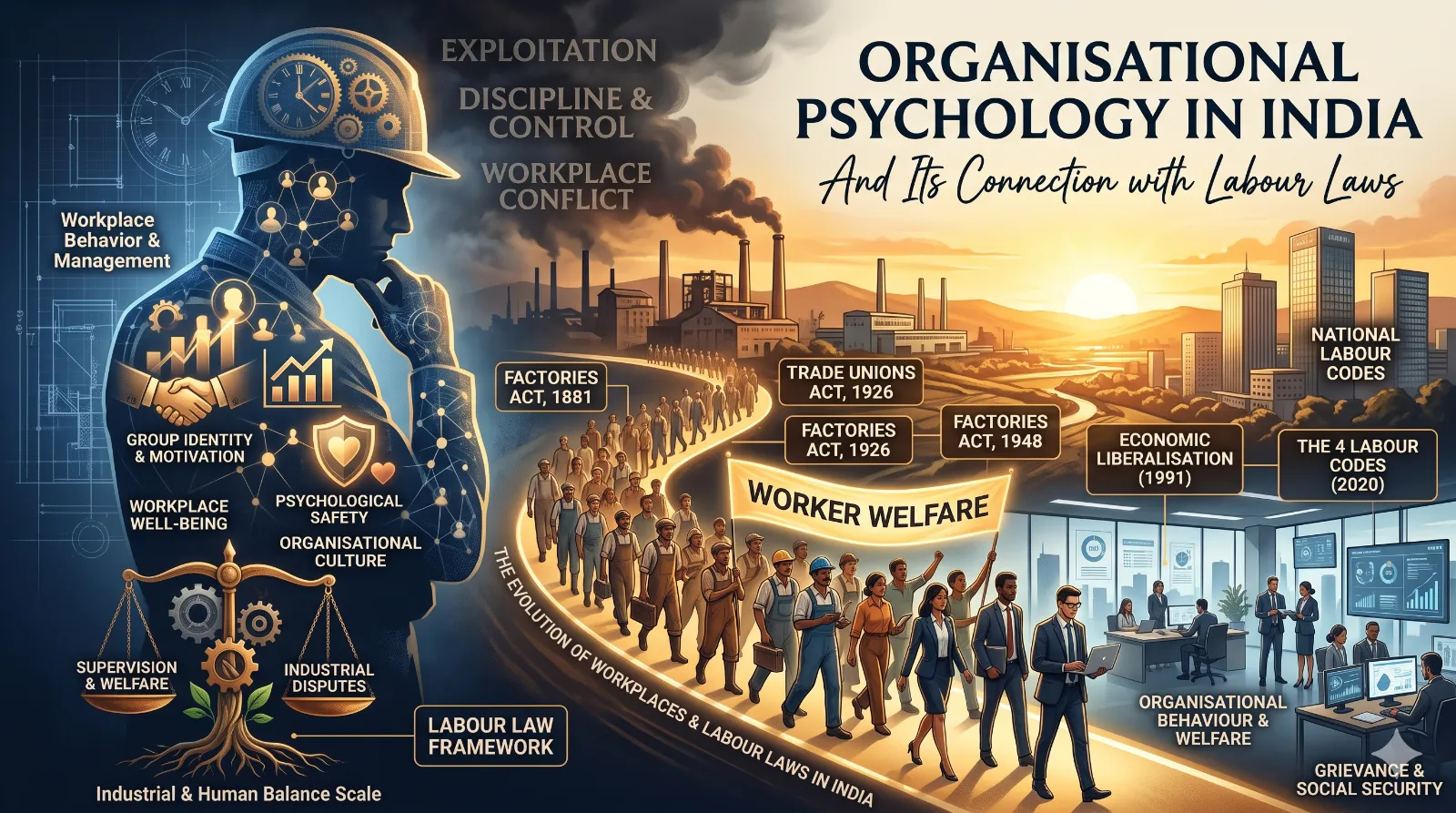
The History of Organisational Psychology in India and Its Connection with Labour Laws
Organisational psychology examines how people behave within organisations, how management influences their performance, and how workplace relationships affect decisionmaking. In India, its development can be understood alongside the country's industrial history, from colonial-era factories to modern corporate workplaces. Although organisational psychology emerged as a distinct discipline largely through Western research, the questions it addresses became increasingly relevant in India as industrial employment expanded and concerns about working conditions, worker representation, and managerial authority grew. The history of Indian labour legislation provides a useful timeline for understanding how the relationship between organisations and the people working within them has changed. From Industrial Control to Human Behaviour 1881–1947: Colonial industrialisation and factory regulation The expansion of factories, railways, mines, and plantations under British rule created a growing need to organise industrial labour. Early management practices emphasised discipline, productivity, and supervision, while workers faced concerns about working hours, safety, and welfare. The Factories Act, 1881, marked an early attempt to regulate factory employment in India. It was followed by further legislation, including the Factories Act, 1948, which developed a broader framework for factory health, safety, and welfare.
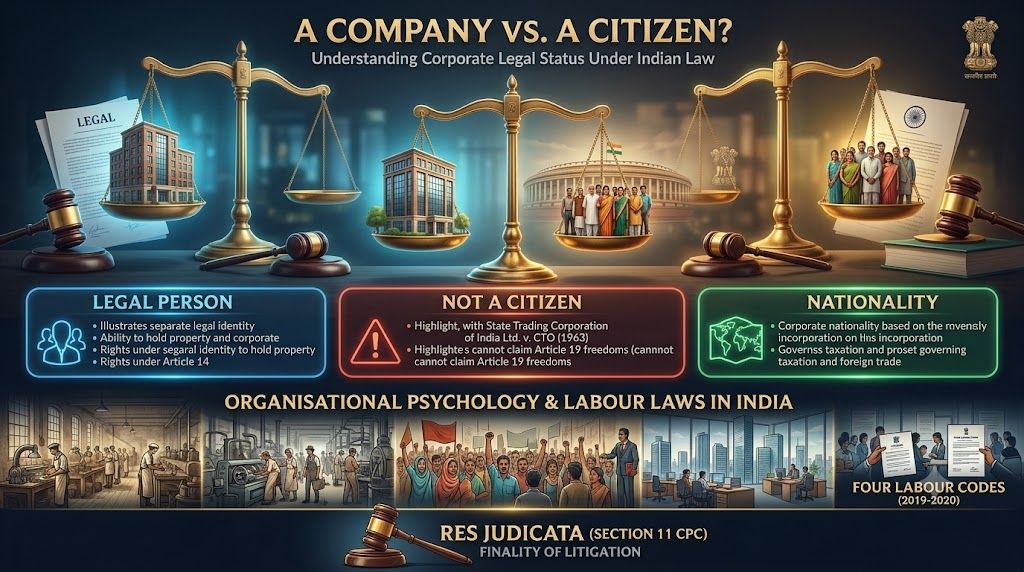
Is a Company a Citizen or a National? Understanding the Position Under Indian Law
Can a company incorporated in India claim the same constitutional status as an Indian citizen? At first glance, the answer might appear obvious. A company may be established under Indian law, conduct business within the country, employ Indian citizens, and contribute significantly to the national economy. Yet, despite its distinct legal identity, a company does not enjoy every right available to an individual. This distinction came into sharp focus before the Supreme Court of India in State Trading Corporation of India Ltd. v. Commercial Tax Officer, AIR 1963 SC 1811, a landmark judgment that clarified the constitutional position of companies and established an important distinction between legal personality, citizenship, and corporate nationality.