From Litigation to Corporate Law: How Research Changed My Career
When I started my legal career, my focus was litigation. I enjoyed the practical side of law. I was comfortable with drafting, understanding cases, preparing arguments, reading judgments and dealing with legal issues. Over time, I became confident in my litigation skills and in the kind of work I was doing.

When I started my legal career, my focus was litigation. I enjoyed the practical side of law. I was comfortable with drafting, understanding cases, preparing arguments, reading judgments and dealing with legal issues. Over time, I became confident in my litigation skills and in the kind of work I was doing.
When I started my legal career, my focus was litigation.
I enjoyed the practical side of law. I was comfortable with drafting, understanding cases, preparing arguments, reading judgments and dealing with legal issues. Over time, I became confident in my litigation skills and in the kind of work I was doing.
But somewhere along the way, I felt that I wanted to explore more.
I wanted to understand the corporate side of the legal profession as well.
I wanted to know how law firms and corporate legal teams worked, how transactions were handled, how legal opinions were prepared and how legal research was used in a more structured professional environment.
So, I started applying to different firms and companies.
And that is where the problem started.
I Was Getting Rejected, But I Did Not Know Why
I applied to multiple places.
I got rejected.
I applied again.
I got rejected again.
And after a point, the rejection started becoming confusing for me.
I knew I could draft.
I had practical litigation experience.
I understood legal concepts.
I could read and analyse judgments.
I had worked on real legal matters.
So naturally, I kept asking myself:
What exactly is missing from my profile?
I was confident about my skills, but somehow my applications were not reflecting that confidence to the recruiters.
At that stage, I did not really understand the difference between possessing a skill and being able to demonstrate that skill on paper.
That changed because of a simple conversation.
A Junior Suggested That I Start Publishing Research Papers
One of my juniors told me something that stayed with me.
He suggested that I start writing and publishing research papers.
His point was simple.
If I wanted firms to understand that I could research, analyse legal issues and write professionally, I needed something on my profile that actually demonstrated those abilities.
At that time, I had never looked at research publications from that perspective.
Like many people, I used to associate research papers more with academics, students pursuing higher studies, professors or people interested in teaching.
I did not initially think of research papers as a career-building tool for a practising lawyer.
But I decided to try.
And that decision changed the way I looked at research completely.
I Started Writing Research Papers
When I started working on research papers, I realised that research was very different from simply reading a few cases and writing about them.
It required me to go deeper.
I had to identify an issue.
I had to understand the existing law.
I had to study judgments.
I had to analyse different viewpoints.
I had to understand whether there were gaps in the existing legal framework.
I had to structure my thoughts properly.
And most importantly, I had to justify whatever I was writing.
That process slowly improved the way I approached legal problems.
Instead of simply asking, “What does the law say?”, I started asking:
Why does the law say this?
How have courts interpreted it?
Are there conflicting views?
What is the practical impact?
Is there a gap in the law?
How is the same issue handled in another jurisdiction?
What could be a better approach?
That shift in thinking helped me far beyond the research papers themselves.
My Profile Started Showing What I Could Actually Do
Earlier, I could write “legal research” or “drafting” under the skills section of my CV.
But so could thousands of other applicants.
There was nothing wrong with mentioning those skills, but I slowly understood that recruiters needed some evidence.
My research publications became that evidence.
They showed that I could take a legal issue, study it independently, analyse it and present a structured argument.
The publications gave my profile something that my earlier CV was missing.
They showed my work instead of simply describing my skills.
And then I applied again.
This time, things changed.
I Finally Got the Corporate Opportunity I Was Looking For
When I applied to a corporate firm again, my profile was different.
My litigation experience was still there.
My drafting experience was still there.
But now I also had research publications that reflected my analytical and research capabilities.
This time, I was selected.
I entered the corporate field and finally got the opportunity I had been looking for.
And once I started working there, I realised something even more important.
Research was not just useful for getting selected.
It was useful almost every single day.
Research Is Everywhere in the Legal Profession
The more I worked, the more I realised that legal research is not limited to universities or academic journals.
It is everywhere.
When you advise a client, you research.
When you prepare a legal opinion, you research.
When you study whether a particular business decision complies with the law, you research.
When you draft an agreement involving an unfamiliar issue, you research.
When you study new regulations, judicial developments or compliance requirements, you research.
Even when you are trying to understand the possible legal consequences of a decision, your ability to research becomes extremely important.
That was when I understood the actual value of the research papers I had written.
The publication itself was important.
But the skill I developed while working on those papers was even more important.
Your CV Can Mention Your Skills. Your Work Has to Prove Them.
This is something I now tell students and young professionals very often.
Almost everyone writes things like:
Legal Research
Drafting
Critical Thinking
Analytical Skills
Communication Skills
on their CV.
But a recruiter may still ask:
Where have you demonstrated these skills?
That is where your work matters.
A strong research paper can show how deeply you understand a subject.
Your publications can show the areas you are genuinely interested in.
And if you consistently research a particular field, your profile slowly starts developing an identity.
For example, if someone regularly writes on corporate law, competition law, intellectual property, arbitration or technology law, their research begins to show a clear professional interest.
That can help during internships, placements, job applications, LL.M. applications and even professional networking.
The Rejections Taught Me Something Important
When I look back at that phase of my career, I do not see those rejections in the same way anymore.
At that time, I thought:
Why are they rejecting me when I know I can do the work?
Later, I understood that knowing something and communicating that capability through your profile are two different things.
I had practical experience.
I had drafting skills.
I had litigation exposure.
But I had not created enough visible proof of my research and analytical abilities.
Research publications helped me bridge that gap.
And once I started working in the corporate field, I realised how valuable that research mindset actually was.
Research Became More Than a Publication for Me
Today, when I talk about research, I do not see it merely as a certificate or another line on a CV.
For me, research became a professional skill.
It taught me how to question.
How to investigate.
How to analyse.
How to form an argument.
How to support that argument with authority.
And how to communicate complex legal issues clearly.
Most importantly, it taught me that sometimes you may already have the capability, but you still need to build something that allows other people to recognise it.
For me, research papers became that bridge.
They helped me move from litigation into the corporate field.
But more than that, they changed the way I approached the law itself.
And that is why, even today, I strongly believe that research should not be treated merely as an academic requirement.
If done properly, it can help you understand your field, develop expertise, strengthen your professional profile and sometimes even open a door that previously remained closed.
Because your CV can tell people what you have done, but your research can show them how you think.
Comments
You may also like

The Doctrine of Res Judicata under Section 11 CPC: Finality of Litigation and Its Limits
Courts exist to resolve disputes, not to keep them alive indefinitely. Section 11 of the Code of Civil Procedure, 1908 (CPC), embodies this principle through the doctrine of res judicata, which prevents parties from reopening matters that have already been finally decided by a competent court. The doctrine protects litigants from repeated proceedings, preserves judicial resources, and gives authority to judicial decisions. However, applying res judicata requires more than establishing that two cases concern similar facts. The nature of the earlier decision, the identity of the parties, the issues adjudicated, and the competence of the court must all be examined. The eight Explanations appended to Section 11 clarify the scope of the doctrine and address situations in which a matter may be treated as already decided, even when it was not expressly determined in the earlier proceedings.

The History of Organisational Psychology in India and Its Connection with Labour Laws
Organisational psychology examines how people behave within organisations, how management influences their performance, and how workplace relationships affect decisionmaking. In India, its development can be understood alongside the country's industrial history, from colonial-era factories to modern corporate workplaces. Although organisational psychology emerged as a distinct discipline largely through Western research, the questions it addresses became increasingly relevant in India as industrial employment expanded and concerns about working conditions, worker representation, and managerial authority grew. The history of Indian labour legislation provides a useful timeline for understanding how the relationship between organisations and the people working within them has changed. From Industrial Control to Human Behaviour 1881–1947: Colonial industrialisation and factory regulation The expansion of factories, railways, mines, and plantations under British rule created a growing need to organise industrial labour. Early management practices emphasised discipline, productivity, and supervision, while workers faced concerns about working hours, safety, and welfare. The Factories Act, 1881, marked an early attempt to regulate factory employment in India. It was followed by further legislation, including the Factories Act, 1948, which developed a broader framework for factory health, safety, and welfare.
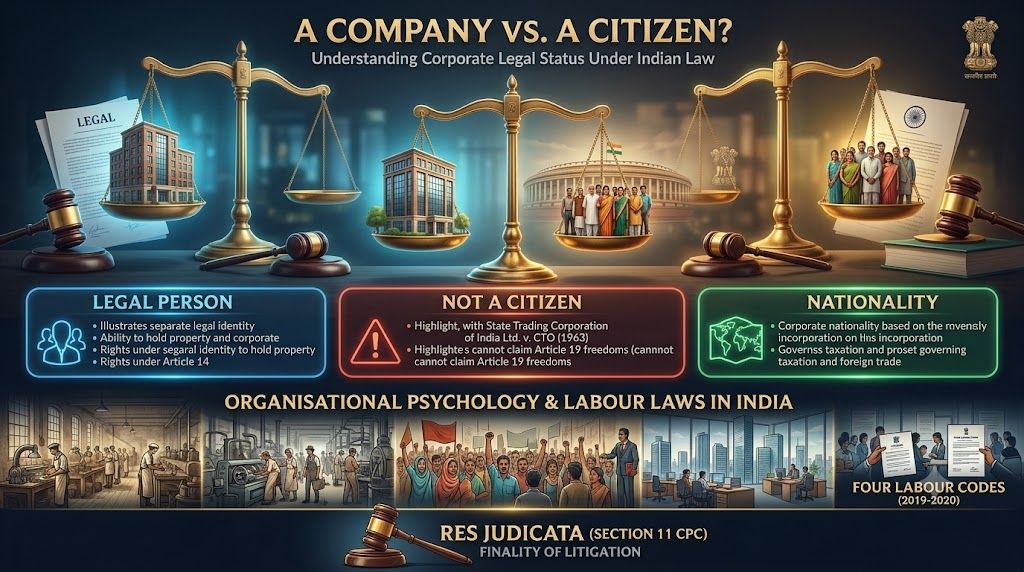
Is a Company a Citizen or a National? Understanding the Position Under Indian Law
Can a company incorporated in India claim the same constitutional status as an Indian citizen? At first glance, the answer might appear obvious. A company may be established under Indian law, conduct business within the country, employ Indian citizens, and contribute significantly to the national economy. Yet, despite its distinct legal identity, a company does not enjoy every right available to an individual. This distinction came into sharp focus before the Supreme Court of India in State Trading Corporation of India Ltd. v. Commercial Tax Officer, AIR 1963 SC 1811, a landmark judgment that clarified the constitutional position of companies and established an important distinction between legal personality, citizenship, and corporate nationality.