Economic Analysis of Tort Law: Efficiency, Deterrence and Compensation
When someone causes harm to another person, tort law asks a familiar question: who should bear the loss?
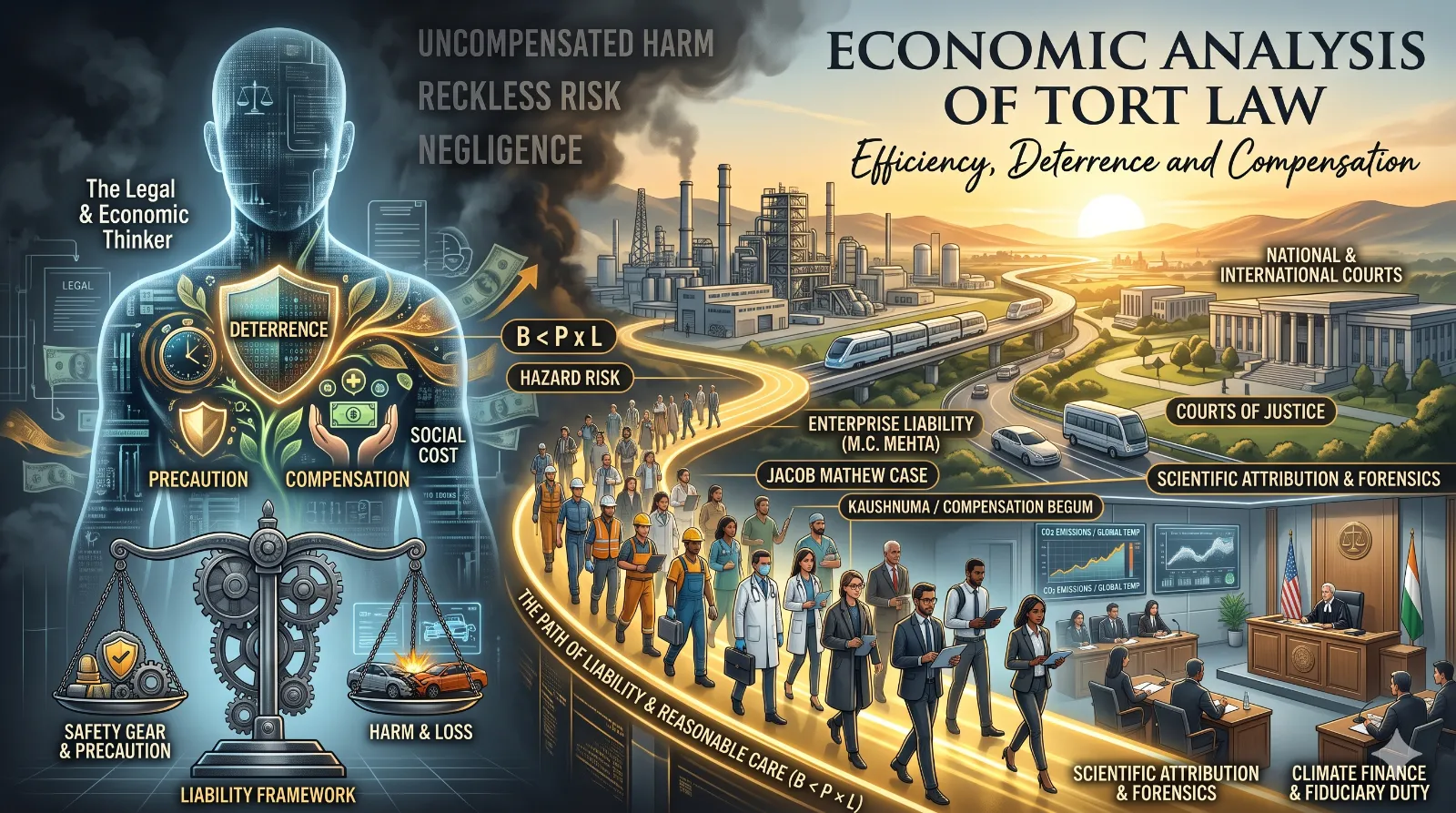
When someone causes harm to another person, tort law asks a familiar question: who should bear the loss?
When someone causes harm to another person, tort law asks a familiar question: who should bear the loss?
Traditionally, the answer has been approached through ideas of fault, justice, responsibility, and compensation. But there is another way of looking at the same question. What if tort law is also a system for influencing behaviour and deciding how the costs of accidents should be distributed across society?
This is where the economic analysis of tort law becomes relevant.
The economic approach does not necessarily replace ideas of justice or morality. Instead, it asks whether legal rules can encourage people and institutions to take appropriate precautions, reduce the occurrence of harm, and allocate the costs of accidents in a socially efficient manner.
Scholars such as Ronald Coase, Guido Calabresi, and Richard Posner played a major role in developing the economic analysis of law. Their work shifted attention towards concepts such as social cost, deterrence, precaution, and efficiency.
For tort law, the central question becomes relatively simple:
Who is in the best position to prevent the harm, and how should the law make them bear its cost?
Tort Law and the Idea of Social Cost
Tort law generally operates after harm has occurred. Someone has been injured, property has been damaged, or an individual's rights have been violated. The traditional function of tort law is therefore corrective. It attempts to compensate the person who suffered the loss.
The economic approach adds another dimension.
Every accident carries a cost. There may be medical expenses, property damage, loss of income, legal costs, and the less easily measurable costs of pain and suffering. Preventing accidents also has a cost because individuals and businesses must spend money and resources on safety measures.
The objective, therefore, is not necessarily to eliminate every possible accident. Complete prevention may itself be economically unrealistic. Instead, the law should encourage a level of precaution where the cost of preventing harm is justified by the harm that precaution can prevent.
This idea can be traced to Ronald Coase's influential work, The Problem of Social Cost. Coase demonstrated how transaction costs and the allocation of legal rights can affect the way resources are used.
Guido Calabresi, in The Costs of Accidents, developed the economic analysis of accidents further and introduced the idea of identifying the cheapest cost avoider, meaning the person or institution that can prevent the accident at the lowest overall cost.
This concept provides a useful lens through which several tort doctrines can be examined.
Who Should Pay for Dangerous Activities?
Consider a company operating an industrial facility involving hazardous substances. If an accident occurs and toxic material escapes, who should bear the resulting costs?
One answer is to place liability on the enterprise that created the risk.
This reasoning can be seen in Rylands v. Fletcher, where liability was imposed in relation to the escape of a dangerous substance from land.
The principle becomes even more significant in Indian law through the Supreme Court's decision in M.C. Mehta v. Union of India, commonly known as the Oleum Gas Leak case.
In that case, the Supreme Court developed the doctrine of absolute liability for enterprises engaged in hazardous or inherently dangerous activities. Such enterprises could be held liable for harm resulting from their activities without relying on the exceptions traditionally associated with strict liability.
Viewed economically, the principle has an important function. If an enterprise creates a significant risk, making it bear the cost of the resulting harm gives it an incentive to invest in safety measures.
The law therefore does more than compensate the victim after an accident. It can also influence how the enterprise behaves before the accident occurs.
Negligence and the Cost of Precaution
The economic analysis becomes particularly interesting when examining negligence.
A negligence rule does not require people to eliminate every conceivable risk. Instead, it asks whether the defendant failed to exercise the level of care expected in the circumstances.
This can be understood economically through the famous Hand Formula, associated with Judge Learned Hand's decision in United States v. Carroll Towing Co.
The formula can be expressed as:
B<P×L
Here, B represents the burden of taking precautions, P represents the probability of harm, and L represents the seriousness or magnitude of the resulting loss.
The underlying idea is straightforward. If the cost of taking a precaution is lower than the expected harm it could prevent, failing to take that precaution may be considered unreasonable.
This approach attempts to connect negligence with rational decision-making about risk.
Indian law does not mechanically apply the Hand Formula. However, the idea of reasonable care remains central to negligence law.
In Jacob Mathew v. State of Punjab, the Supreme Court addressed medical negligence and emphasised that a professional should not be held liable merely because a better course of treatment was available or because an
error of judgment occurred. The relevant question is whether the professional acted with the level of care expected from a reasonably competent practitioner.
This approach also demonstrates why excessive liability can create problems. If professionals face liability for every unsuccessful outcome, they may be encouraged to avoid socially valuable activities altogether.
The economic concept is therefore not simply more liability. It is appropriate liability.
Strict Liability, Absolute Liability and No-Fault Liability
Tort law uses different liability rules, and each can create different economic incentives.
Under negligence, liability generally depends on a failure to exercise reasonable care.
Under strict liability, liability may arise from the nature of the activity even without proof of negligence.
Under absolute liability, as developed in M.C. Mehta, enterprises engaged in hazardous activities can be held liable without the traditional exceptions associated with strict liability.
There is also no-fault liability, where compensation may be available without requiring the victim to establish negligence.
The economic consequences of these systems differ.
A negligence regime places emphasis on precautions. Strict or absolute liability places greater emphasis on the activity itself and the risks created by the defendant. No-fault systems can reduce the costs and difficulties involved in proving fault and may allow victims to obtain compensation more quickly.
In Kaushnuma Begum v. New India Assurance Co. Ltd., the Supreme Court considered the relationship between compensation and liability in the context of motor vehicle accidents. Such compensation mechanisms demonstrate how tort-related systems can sometimes prioritise efficient compensation and distribution of loss rather than requiring victims to establish fault in every case.
Compensation Is More Than a Payment
Damages are one of the most visible functions of tort law.
When a court awards compensation, it is attempting to address the loss suffered by the claimant. But from an economic perspective, damages can also influence future behaviour.
If businesses know that unsafe practices can result in substantial liability, they have an incentive to invest in safety.
If the law imposes very little liability, however, an actor may have less economic reason to spend resources preventing harm.
The challenge is to strike a balance. Compensation should adequately address the victim's loss without creating forms of liability that discourage socially useful activity or impose costs disproportionate to the risk involved.
The Supreme Court's decision in Gobald Motor Service Ltd. v. R.M.K. Veluswami illustrates the importance of assessing compensation for wrongful death through the economic consequences suffered by the dependants of the deceased.
Yet monetary compensation also exposes one of the limits of economic analysis. Not every form of harm can be neatly converted into a monetary figure.
The loss of a loved one, physical pain, emotional suffering, and damage to dignity are not simply economic variables.
When the State Becomes the Defendant
The economic analysis of tort law becomes even more complicated when the defendant is the State.
In Rudul Sah v. State of Bihar, the Supreme Court awarded compensation for an unconstitutional deprivation of liberty.
Similarly, in Nilabati Behera v. State of Orissa, compensation was awarded in the context of custodial death and violation of fundamental rights.
These decisions are generally understood through the lens of constitutional rights and public law. Yet they can also be viewed through the economic idea of deterrence.
Government institutions control systems through which public services are delivered. Holding the State accountable for certain violations can create incentives for institutions to improve those systems and reduce preventable harm.
The idea resembles Calabresi's concept of the cheapest cost avoider. Where an institution controls the system that produced the harm, placing responsibility on that institution may encourage systemic improvements.
Efficiency Has Its Limits
Economic analysis provides a useful way of understanding tort law, but it has an obvious limitation.
Not everything that matters can be measured in economic terms.
A purely economic approach may treat an accident as a calculation involving probabilities, costs, and expected losses. But tort law also deals with dignity, bodily integrity, fairness, rights, and social responsibility.
This tension can be seen in Kasturi Lal v. State of Uttar Pradesh, where the Supreme Court applied the doctrine of sovereign immunity in relation to a claim arising from police negligence.
From a purely economic perspective, immunity can reduce incentives for the State to take precautions. Yet the decision reflected broader legal considerations concerning the nature and scope of governmental functions at the time.
The case demonstrates an important limitation of law and economics. Efficiency may be an important consideration, but it cannot always determine the legal outcome.
The Indian Approach: Efficiency and Justice
Indian tort jurisprudence does not fit neatly into a purely economic model.
Cases such as M.C. Mehta, Rudul Sah, Nilabati Behera, and Kasturi Lal demonstrate that Indian courts have frequently considered constitutional values, public interest, individual rights, and social justice alongside questions of liability and compensation.
This makes the Indian experience particularly interesting from a law and economics perspective.
The law may seek to deter dangerous conduct, but it may also seek to protect vulnerable individuals.
It may attempt to minimise social costs, but it must also determine what constitutes a fair distribution of those costs.
It may encourage efficient behaviour, but efficiency cannot necessarily justify every outcome.
The relationship between economics and tort law is therefore better understood as a balance rather than a replacement of one theory with another.
Conclusion
Economic analysis changes the way we look at tort law.
Instead of viewing tort law only as a system that responds to harm after it has occurred, it allows us to see liability rules as instruments that can influence behaviour before harm occurs.
Negligence encourages reasonable precautions. Strict and absolute liability place greater responsibility on those who engage in dangerous activities. No-fault systems can facilitate compensation without requiring victims to establish negligence. Damages can compensate victims while also influencing future behaviour.
Indian courts have developed these principles within a broader framework that includes constitutional values, human dignity, public interest, and social justice.
That is ultimately where the economic analysis of tort law becomes most interesting. The question is not simply how much an accident costs. It is who should bear that cost, who could have prevented it, and what the law should do to reduce the likelihood of the next accident.
Tort law therefore sits at the intersection of efficiency, deterrence, compensation, and justice. Economic analysis helps explain one part of that intersection, but the law remains broader than economics alone.
Comments
You may also like
From Crisis to Cooperation: The Formation of the IMF and World Bank
What happens when the economic problems of one country begin to affect the rest of the world?

Analysing the Role of Litigation in Addressing Climate Change
Climate change, caused by the buildup of greenhouse gases (GHGs) in the atmosphere, has resulted in increasing global temperatures, occurrence of extreme weather events, melting glaciers, and sea level rise. The inability of some governments and corporations to fulfill their climate obligations has raised a crucial question: Can litigation be used to bridge the regulatory and policy gaps left behi

Asymmetric Cryptography: How Public Keys Secure the Digital World
The modern legal system increasingly operates in a world where documents are created, signed, transmitted, and stored without ever taking physical form. Contracts are accepted through emails, government documents are digitally signed, banking transactions are authenticated electronically, and evidence that once existed only on paper may now consist of messages, server logs, CCTV footage, cloud rec