Analysing the Role of Litigation in Addressing Climate Change
Climate change, caused by the buildup of greenhouse gases (GHGs) in the atmosphere, has resulted in increasing global temperatures, occurrence of extreme weather events, melting glaciers, and sea level rise. The inability of some governments and corporations to fulfill their climate obligations has raised a crucial question: Can litigation be used to bridge the regulatory and policy gaps left behi
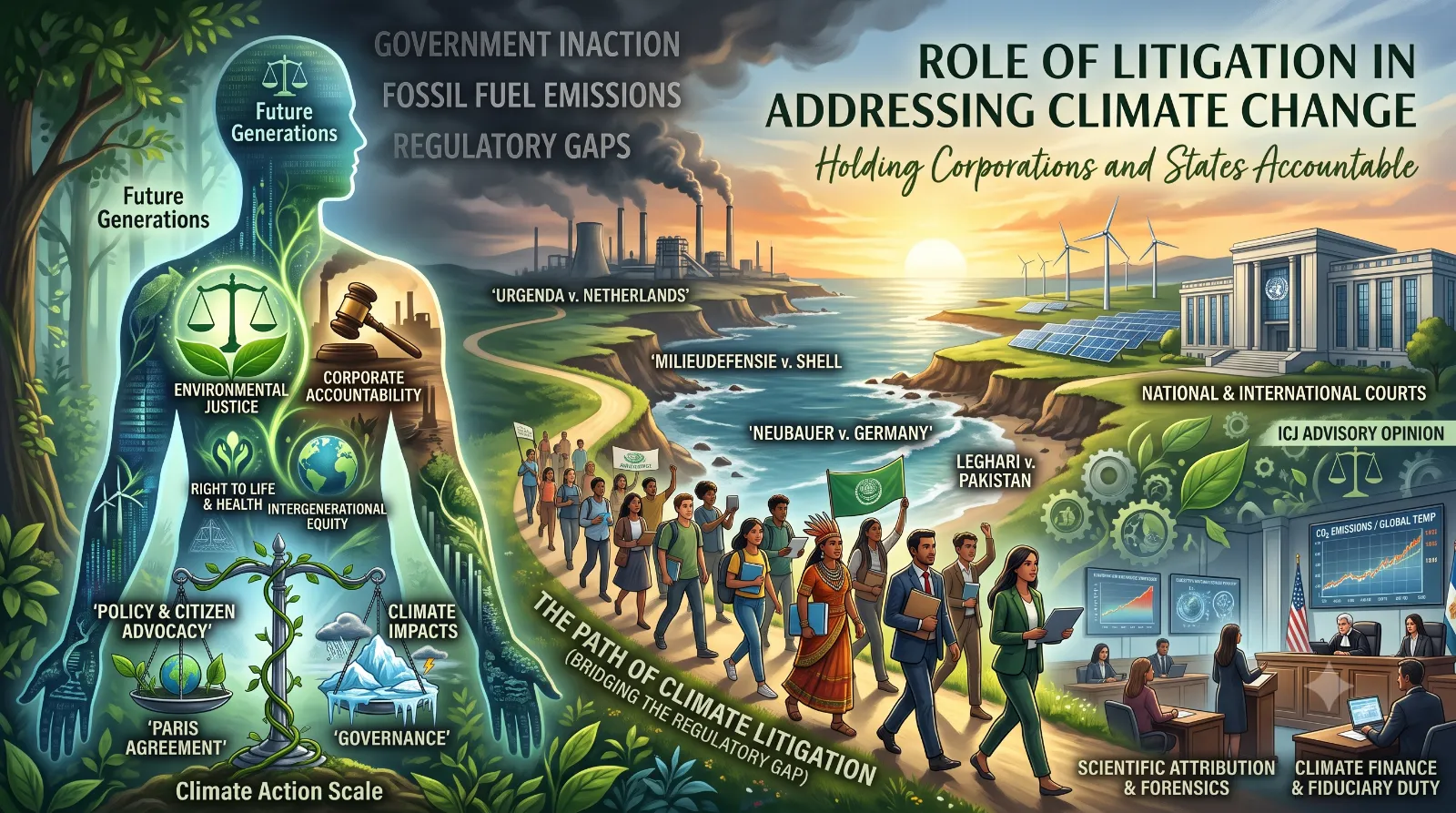
Climate change, caused by the buildup of greenhouse gases (GHGs) in the atmosphere, has resulted in increasing global temperatures, occurrence of extreme weather events, melting glaciers, and sea level rise. The inability of some governments and corporations to fulfill their climate obligations has raised a crucial question: Can litigation be used to bridge the regulatory and policy gaps left behi
Climate change, caused by the buildup of greenhouse gases (GHGs) in the atmosphere, has resulted in increasing global temperatures, occurrence of extreme weather events, melting glaciers, and sea level rise. The inability of some governments and corporations to fulfill their climate obligations has raised a crucial question: Can litigation be used to bridge the regulatory and policy gaps left behind? Climate litigation is becoming an emerging and widely used tool for holding corporations and states responsible, advancing environmental justice, and implementing international and national climate commitments.
This paper examines the character and path of climate litigation across the world, the legal principles applied, and the influence these cases have possessed on climate governance.
1. The Rise of Climate Litigation
1.1 Historical Context
Climate litigation came into prominence towards the end of the 1990s in developed countries such as the United States and nations within the European Union. Litigation in early cases was centered on contesting the legality of rollbacks on regulations or asking for enhanced compliance with environmental law. Litigation tactics changed from procedural claims over time to constitutional and human rights-based claims.
1.2 Definition and Scope
Climate litigation is legal proceedings in which climate change and its impacts are central to the issue. Such lawsuits can be brought against governments, companies, or individuals and may be brought before local, national, or international courts. They tend to include:
• Requesting more stringent mitigation or adaptation action.
• Opposing poor environmental impact assessments.
• Making polluters pay for climate change damages.
2. Types of Climate Litigation
2.1 Government-Targeted Litigation
These cases are generally brought by citizens, NGOs, or communities against governments at a national or local level for not complying with their legal commitments under climate change.
Example: Urgenda Foundation v. The Netherlands (2015)
In this landmark case, the Dutch Supreme Court held that the government must reduce emissions by at least 25% by 2020 compared to 1990 levels, citing its duty to protect human rights under the European Convention on Human Rights.
2.2 Corporate Accountability Litigation
Fossil fuel companies and other polluters have been increasingly targeted in litigation aiming to hold them accountable for their contributions to global warming.
Example: Milieudefensie v. Royal Dutch Shell (2021)
A court in the Netherlands told Shell to cut its greenhouse gas emissions by 45% by 2030, finding that the company owed a duty of care under Dutch civil law and human rights.
2.3 Rights-Based Litigation
Here, plaintiffs invoke that inaction on climate contradicts fundamental rights like the right to life, health, clean environment, and dignity.
Example: Neubauer et al. v. Germany (2021)
Germany's Constitutional Court held that the Federal Climate Change Act was partially unconstitutional because it did not adequately safeguard future generations against climate damage.
2.4 Procedural and Regulatory Issues
Procedural validity of environmental clearances is challenged by litigants, or it is contended that climate change has not been taken into account sufficiently in development projects.
Example: Friends of the Earth v. Heathrow Airport (2020)
The UK Court of Appeal held that the government's approval of Heathrow's third runway was unlawful because it failed to take into account the Paris Agreement.
3. The Role of Litigation in Shaping Climate Policy
3.1 Enforcement of Legal Obligations
Litigation has served to enforce domestic environmental legislation and international obligations, including those under the Paris Agreement. Through enforcing governments and corporations, courts have become engaged actors in climate governance.
3.2 Fostering Policy Change
High-profile cases tend to galvanize legislative action. For instance, following the Urgenda judgment, the government of the Netherlands implemented more assertive climate policies.
Judicial oversight can be a spur to political will.
3.3 Creating Legal Precedents
Climate cases have assisted in the interpretation of constitutional and human rights law within an environmental context. These judgments not only have application domestically but shape other jurisdictions by offering legal blueprints for action.
4. Limitations and Challenges of Climate Litigation
4.1 Jurisdictional Challenges
Numerous courts refrain from intervening in issues deemed to be in the preserve of the executive or legislative arms. The separation of powers doctrine repeatedly creates barriers to visionary climate judgments.
4.2 Standing and Justiciability
Plaintiffs must show that they are directly impacted by climate change, which is challenging considering the global and diffuse nature of the issue. Courts can reject claims on the basis that they present non-justiciable political questions.
4.3 Scientific Uncertainty
While scientific consensus regarding climate change is solid, attributing particular harms to particular emitters is complicated. This makes liability claims challenging and damage awards uncommon.
4.4 Implementation Challenges
Even if decisions are pro-climate action, making governments or corporations implement court orders is still a tall order. There are weak or non-existent mechanisms for enforcement.
5. Climate Litigation in Developing Countries
Developing countries are becoming the center of climate litigation, especially based on grounds of environmental justice, indigenous rights, and intergenerational equity.
Example: Leghari v. Federation of Pakistan (2015)
A farmer filed suit against the Pakistan government for a failure to pursue its climate policy framework. In Ashgar Leghari v. State (India), the Lahore High Court deemed that this passivity infringed upon citizens' constitutional rights to establish a Climate Change Commission.
Example: Ashgar Leghari v. State (India)
In India, the National Green Tribunal and several High Courts have also stepped up to judge environmental and climate-related cases, although no milestone climate case in the manner of Urgenda yet exists.
Resource limitations, limited legal know-how, and delays in courts in these regions however often thwart development.
6. The Emergence of Strategic Litigation
Strategic litigation is planned, legal action with the aim of not only securing a victory in court, but also to frame public debate, shape policy, and engage citizens. Most climate cases now constitute strategic litigation.
Groups such as Greenpeace, EarthRights International, and ClientEarth have spearheaded the role of litigation as a change tactic. Strategic cases have the goals of:
• Creating legal precedents.
• Raising awareness.
• Prying pressure on governments and industry.
7. Intersection with International Law
While the majority of climate cases are national, international law is playing an increasingly complementary role. Litigants regularly invoke the Paris Agreement, UN Framework Convention on Climate Change (UNFCCC), and customary international law.
Recent Development: Advisory Opinion Request to the International Court of Justice (2023)
Pacific island countries, led by Vanuatu, have asked the ICJ for an advisory opinion on international law obligations of states on climate change. Such an opinion, although non-binding, could have a significant impact on national courts.
8. Future of Climate Litigation
8.1 Youth and Intergenerational Lawsuits
Youth around the world are taking climate inaction cases to court, claiming that they are denied a livable future.
Such cases, sometimes emotionally and morally strong, are increasingly gaining legal traction.
8.2 Climate Finance and Fiduciary Duty
Cases are being brought against investment funds, banks, and pension trustees for not taking climate risks into account when making financial decisions.
Example: McVeigh v. Retail Employees Superannuation Trust (Australia, 2020)
An Australian fund paid out to a beneficiary who sued the fund for not disclosing and handling climate-related financial risk.
8.3 Climate Migration and Refugee Law
As displacement due to climate change becomes increasingly common, litigation could arise to obtain rights and protections for climate refugees.
Conclusion
Climate litigation has been an effective tool for facing one of the greatest human crises. Although no replacement for strong government action and global cooperation, it fills enforcement gaps, amplifies the voices of vulnerable populations, and pushes policymakers toward more aggressive climate objectives. The increasing sophistication and innovation of legal arguments, as well as increasing judicial willingness to confront climate science and human rights, indicate that climate litigation will increasingly become a powerful tool for accountability and justice.
But for litigation to really supplement more comprehensive climate action, it needs to overcome problems of enforcement, standing, and access to justice, particularly in the Global South. With the impending urgency of the climate crisis, the legal system will be invoked more than ever before, not just to rule on past wrongs but to protect the future.
References
1. Burger, M., & Gundlach, J. (2017). The Status of Climate Change Litigation: A Global Review. UN Environment Programme.
2. Setzer, J., & Higham, C. (2022). Global Trends in Climate Change Litigation: 2022 Snapshot. Grantham Research Institute on Climate Change and the Environment.
3. Peel, J., & Osofsky, H. M. (2015). Climate Change Litigation: Regulatory Pathways to Cleaner Energy. Cambridge University Press.
4. United Nations Framework Convention on Climate Change (UNFCCC). (2015). The Paris Agreement.
5. Urgenda Foundation v. State of the Netherlands, ECLI:NL:HR:2019:2006 (Supreme Court of the Netherlands, 20 December 2019).
6. Milieudefensie et al. v. Royal Dutch Shell plc, C/09/571932 / HA ZA 19-379 (District Court of The Hague, 2021).
7. Neubauer, et al. v. Germany, Federal Constitutional Court (BVerfG), 1 BvR 2656/18 (March 24, 2021).
8. Leghari v. Federation of Pakistan, W.P. No. 25501/2015 (Lahore High Court, 2015).
9. Friends of the Earth Ltd v. Heathrow Airport Ltd, [2020] EWCA Civ 214 (UK Court of Appeal).
10. ICJ Press Release. (2023). UN General Assembly Requests Advisory Opinion on Climate Obligations. International Court of Justice.
11. McVeigh v. Retail Employees Superannuation Trust (Australia, Federal Court, 2020).
12. Kotzé, L. J. (2019). A Global Environmental Constitution for the Anthropocene? Transnational Environmental Law, 8(1), 11–33.
13. Rajamani, L., & Peel, J. (2021). The Role of Courts in Advancing Climate Action. Review of European, Comparative & International Law.
Comments
You may also like
From Crisis to Cooperation: The Formation of the IMF and World Bank
What happens when the economic problems of one country begin to affect the rest of the world?
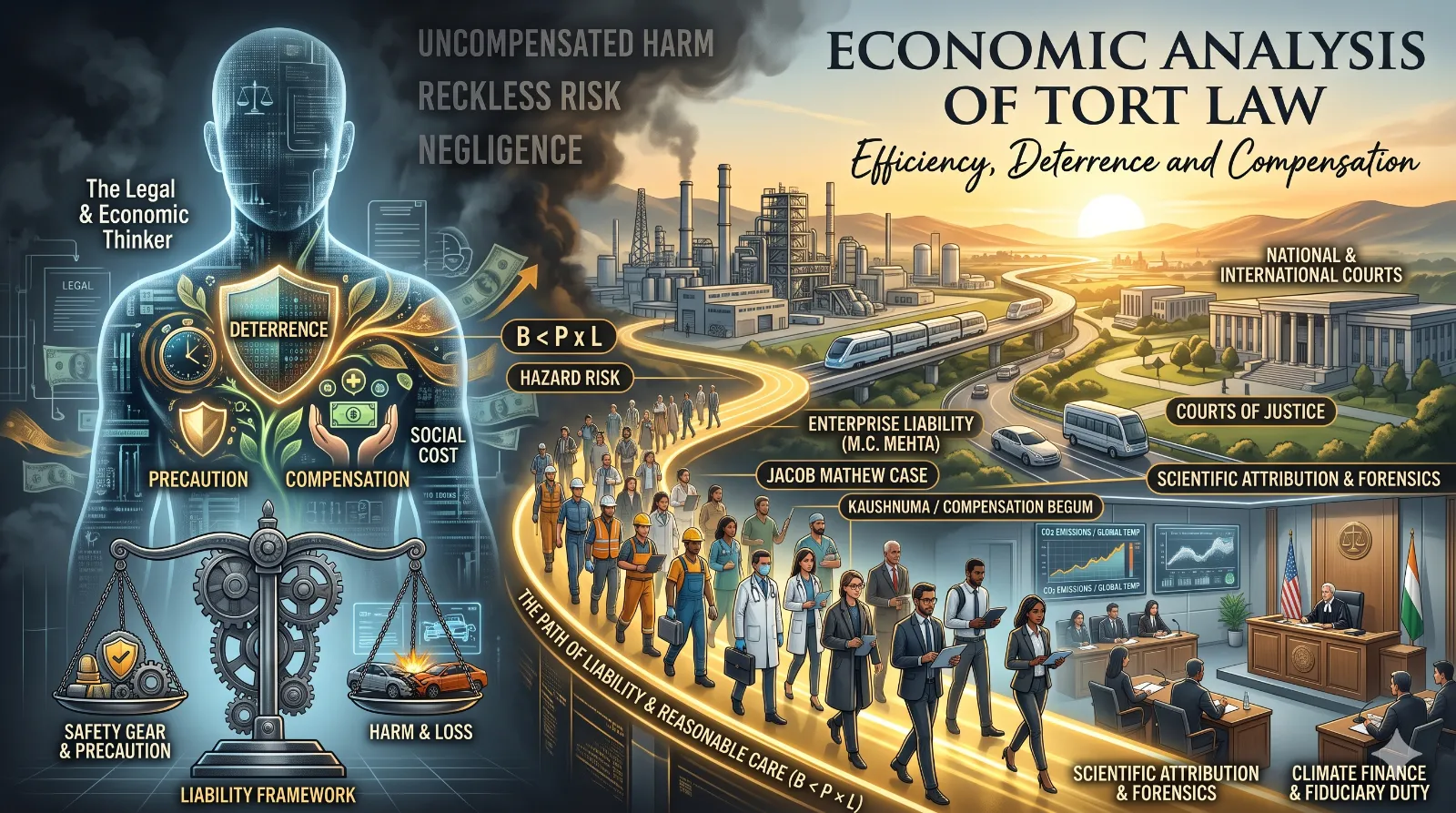
Economic Analysis of Tort Law: Efficiency, Deterrence and Compensation
When someone causes harm to another person, tort law asks a familiar question: who should bear the loss?

Asymmetric Cryptography: How Public Keys Secure the Digital World
The modern legal system increasingly operates in a world where documents are created, signed, transmitted, and stored without ever taking physical form. Contracts are accepted through emails, government documents are digitally signed, banking transactions are authenticated electronically, and evidence that once existed only on paper may now consist of messages, server logs, CCTV footage, cloud rec