Beyond the Boundary: Why I Believe Every Cricketer Needs a Plan B
Growing up in a country like India, where cricket is celebrated almost like a religion, it is difficult not to fall in love with the game. Here, cricket is not merely a sport. It is an emotion that connects millions of people, irrespective of their backgrounds, professions, or ci
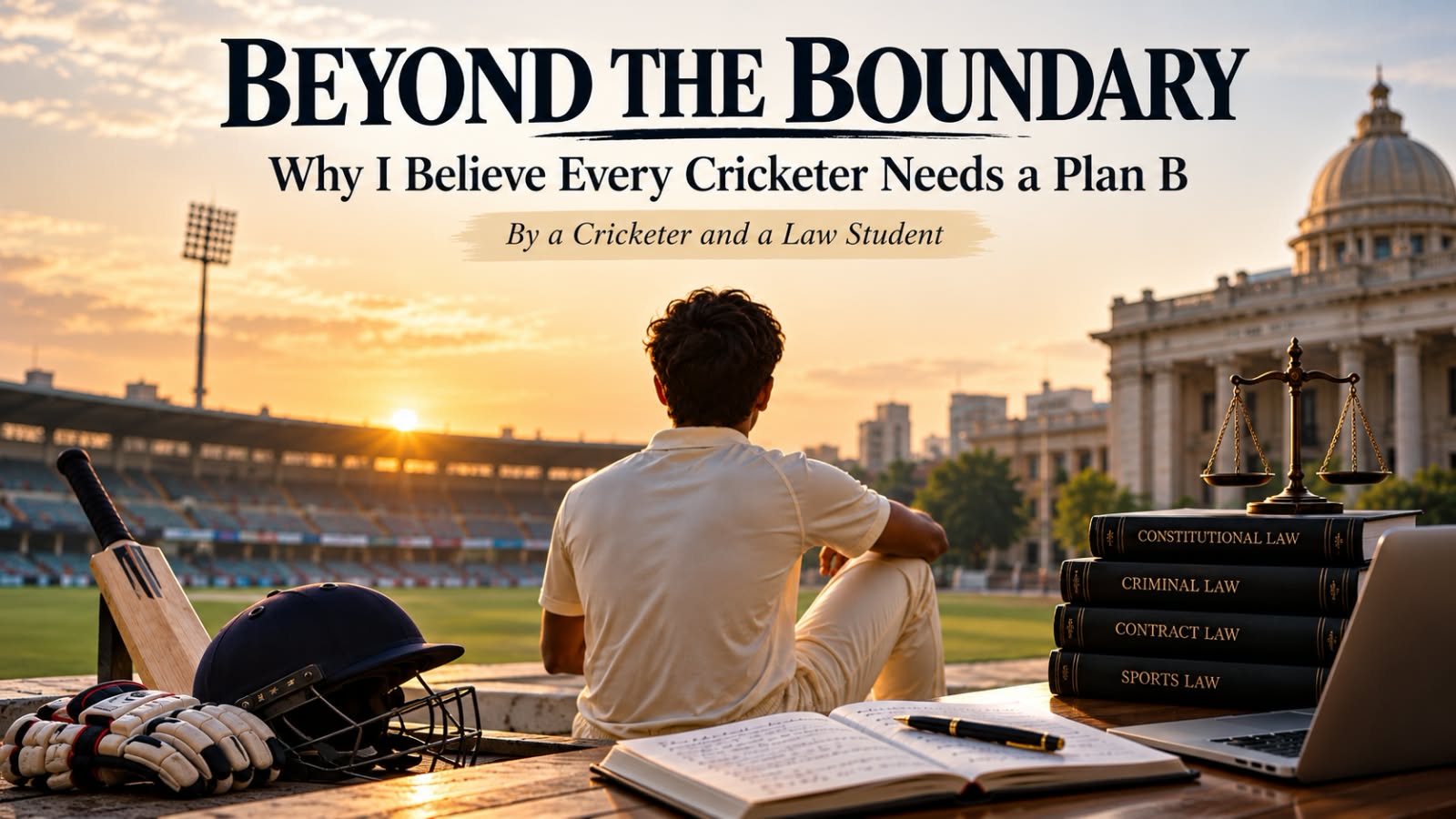
Growing up in a country like India, where cricket is celebrated almost like a religion, it is difficult not to fall in love with the game. Here, cricket is not merely a sport. It is an emotion that connects millions of people, irrespective of their backgrounds, professions, or ci
1. Cricket Is My Passion, But Is Passion Alone Enough?
Growing up in a country like India, where cricket is celebrated almost like a religion, it is difficult not to fall in love with the game. Here, cricket is not merely a sport. It is an emotion that connects millions of people, irrespective of their backgrounds, professions, or circumstances.
I am one of those countless individuals who developed a passion for cricket and decided to pursue it seriously.
For me, cricket has never been just about holding a bat, bowling a delivery, or winning a match. It has been about discipline, dedication, consistency, and the ambition to achieve something meaningful in life.
Like many cricketers, I understand the significance of wearing the Indian jersey. Representing one's country is perhaps one of the greatest ambitions a professional athlete can have.
But as I have grown older and started understanding life beyond the cricket ground, one question has increasingly occupied my mind.
What happens if, despite giving everything to cricket, I never get the opportunity to represent my country?
It is not a comfortable question.
For someone who genuinely loves the game, even considering such a possibility can feel like doubting their own abilities.
But I have come to believe that acknowledging uncertainty is not the same as accepting defeat.
It is simply understanding that life is bigger than one dream.
2. Everyone Sees the Success, But What About the Struggle?
Whenever I watch international cricket, I see players who have achieved what thousands of aspiring cricketers work toward every single day.
The recognition, the packed stadiums, the national anthem, the pride of representing India, and the financial opportunities associated with success make professional cricket an incredibly attractive career.
But being involved in cricket has also made me realise something that people watching from the outside might not completely understand.
The journey of a cricketer is much more uncertain than the success stories we usually celebrate.
Cricket requires an enormous amount of time, energy, and commitment.
There are training sessions, fitness routines, matches, tournaments, and constant efforts to improve performance.
Every match matters because every performance could potentially open another door.
Yet, even after all this, there is no guarantee of reaching the highest level.
I can work on my game, improve my skills, maintain my fitness, and give my best whenever I step onto the field.
But I cannot control every opportunity, selection decision, injury, or circumstance that may influence my career.
And that is perhaps the most difficult reality of professional sports.
Sometimes, being talented is not enough.
Sometimes, working hard is not enough.
Sometimes, despite doing everything within my control, things may not turn out the way I imagined.
This does not mean that I should stop trying.
It means I should understand the difference between pursuing a dream and depending entirely on that dream for my future.
3. The Pressure of Choosing Cricket as a Career
One thing I have realised is that choosing cricket as a profession is very different from choosing most conventional careers.
When I look around, I see people of my age completing their education, getting jobs, preparing for competitive examinations, and gradually becoming financially independent.
Meanwhile, a cricketer's professional journey often follows a completely different timeline.
There is no fixed age at which success is guaranteed.
There is no certainty that years of consistent performance will lead to a particular opportunity.
And there is no straightforward answer to how long someone should continue pursuing professional cricket without achieving their desired breakthrough.
I believe these uncertainties create a kind of pressure that is not always visible.
As a cricketer, I want to give my best years to the game. I want to improve, compete, and explore every opportunity available to me.
But I also know that life comes with responsibilities.
Financial independence matters.
Career stability matters.
And being able to build a meaningful future matters.
I do not want to reach a stage where I look back and realise that I dedicated years to one ambition without preparing myself for any other possibility.
I also do not want to make decisions about my future purely out of fear.
This is where I believe having a Plan B becomes important.
4. Why I Chose Law Alongside Cricket
One of the questions that may arise is why I am pursuing law while also being involved in professional cricket.
After all, cricket and law are two completely different fields.
One demands physical fitness, regular practice, performance, and consistency on the field.
The other requires reading, analytical thinking, understanding legal principles, and developing the ability to interpret and apply the law.
Managing both requires effort, but I do not see them as contradictory ambitions.
I am a cricketer, but I also want to build an identity beyond cricket.
My decision to pursue law does not mean that I have lost confidence in my cricketing career.
It does not mean that I am preparing to leave the sport.
And it certainly does not mean that cricket has become less important to me.
It simply means that I understand the importance of having another professional direction.
Law offers me an opportunity to develop knowledge and skills that are valuable beyond the cricket field.
I find the relationship between sports and law particularly interesting.
Professional sports involve contracts, sponsorship agreements, intellectual property rights, disciplinary matters, governance, and disputes between players and sporting organisations.
As someone who understands cricket from the perspective of a player, I believe legal education could eventually help me understand another side of the sporting world.
Perhaps one day, my experience in cricket and my knowledge of law could complement each other.
Or perhaps my legal career could take an entirely different direction.
I do not know exactly what the future holds, and I think that is perfectly reasonable.
What matters to me is that I am working toward creating opportunities rather than limiting myself to only one possibility.
5. Having a Plan B Does Not Mean I Have Given Up on Plan A
There is a mindset that I believe needs to change, especially among aspiring athletes.
We often associate having an alternative career with a lack of confidence in our primary ambition.
The assumption is that if someone is genuinely passionate about cricket, they should focus exclusively on cricket.
I disagree with this idea.
For me, having a Plan B is not an admission that I cannot succeed in cricket.
It is an acknowledgment that professional sports involve uncertainties that cannot always be controlled.
I can be fully committed to my cricketing career while simultaneously preparing for another profession.
These two decisions do not have to contradict each other.
In fact, having another career option can provide a sense of security.
When my entire future is dependent upon one particular outcome, every disappointment can begin to feel overwhelming.
A poor performance, a missed opportunity, or an unexpected setback may start affecting how I see myself and my future.
But when I know that I am also building something beyond cricket, I can approach the sport with a broader perspective.
I can continue working hard without believing that my entire worth depends on one selection list.
I can appreciate the opportunities I receive without ignoring the realities of life.
And most importantly, I can pursue my passion without allowing uncertainty to dictate every decision I make.
My Plan B is not competing with my dream. It is protecting the future of the person who is chasing that dream.
6. What If I Never Play for Team India?
This is probably the most difficult question to ask myself.
What if I continue playing, practising, improving, and giving everything to cricket but never get the opportunity to wear the Indian jersey?
Will that mean I failed?
Will the years I spent playing cricket become meaningless?
Will all my efforts have been wasted?
I do not think so.
Of course, representing India would be an extraordinary achievement.
But I do not believe that my entire life should be judged by whether I reach that particular milestone.
Cricket has already given me lessons that extend far beyond the game.
It has taught me the importance of discipline, patience, teamwork, consistency, and mental strength.
It has made me understand that every performance will not be my best and that disappointment is an unavoidable part of growth.
These lessons will remain relevant regardless of the profession I eventually pursue.
If I build a successful career in cricket, I will be grateful for the opportunity.
If I build a career in law alongside cricket, I will have another reason to feel proud of myself.
And if life eventually leads me toward a completely different professional path, I would like to believe that the years I spent playing cricket helped shape the person I became.
I also recognise that playing for India is not the only meaningful achievement available within cricket.
Domestic cricket, coaching, sports management, mentoring, and other opportunities can allow someone to remain connected to the game.
I do not want to define success so narrowly that every achievement outside international cricket begins to look like a failure.
Not every cricketer will represent India, but that does not mean every other cricketer has failed.
7. My Dream Is Cricket, But My Future Is Bigger Than One Dream
I often think about how strongly we encourage young people to pursue their passions.
We tell them to dream big, work hard, remain consistent, and never give up.
I believe in all of these things.
But I also believe that we should encourage young athletes to think about their long-term future.
There is nothing wrong with preparing for competitive examinations, completing a degree, developing professional skills, or exploring another career while pursuing sports.
I do not think a cricketer should have to abandon education to prove dedication to the game.
Nor do I believe that pursuing education makes someone any less serious about cricket.
Balancing both is challenging. There are times when academic responsibilities and sporting commitments can demand attention simultaneously.
But I would rather make that effort today than find myself completely unprepared for an unexpected change tomorrow.
I want to be financially independent.
I want to have professional opportunities.
I want to continue learning and developing skills beyond cricket.
And I want to achieve these things without giving up on the sport that remains an important part of my life.
I am not pursuing law because I expect my cricketing journey to end unsuccessfully.
I am pursuing it because I do not believe that preparing for the future should be considered a lack of faith in the present.
Conclusion: I Want to Chase My Dream Without Losing Sight of My Future
Cricket will always hold a special place in my life.
The excitement of stepping onto the field, the satisfaction of performing well, the lessons learned from difficult matches, and the ambition to achieve something significant through the sport are experiences that I value deeply.
I do not know where my cricketing journey will eventually take me.
Maybe I will achieve everything I have dreamed of.
Maybe I will discover opportunities that I cannot even imagine today.
Or maybe my professional journey will take an entirely different direction.
But whatever happens, I do not want to look back with the feeling that my life had only one possible path.
I want to give my best to cricket while also building a future that offers stability, independence, and purpose.
I want to pursue my ambitions without being afraid to acknowledge life's uncertainties.
And I want young cricketers like me to understand that preparing for another career does not make their commitment to cricket any less genuine.
India celebrates the cricketers who make it to the international stage, and rightly so.
But I also believe that the dreams, struggles, and efforts of those who never reach that stage deserve recognition.
Because the value of a cricketer cannot be determined solely by whether their name appears on an international team sheet.
For me, cricket is more than a career. It is a passion that has influenced the way I approach life.
But I also know that my life is bigger than cricket.
I want to wear the Indian jersey, but I also want to be prepared for a future in which that dream may or may not become reality.
Because having a Plan B does not mean I am preparing to fail at Plan A. It simply means that I refuse to let one uncertain outcome decide the direction of my entire life.
After all, cricket is a significant part of who I am, but it is not the only thing I can become.
Comments
You may also like
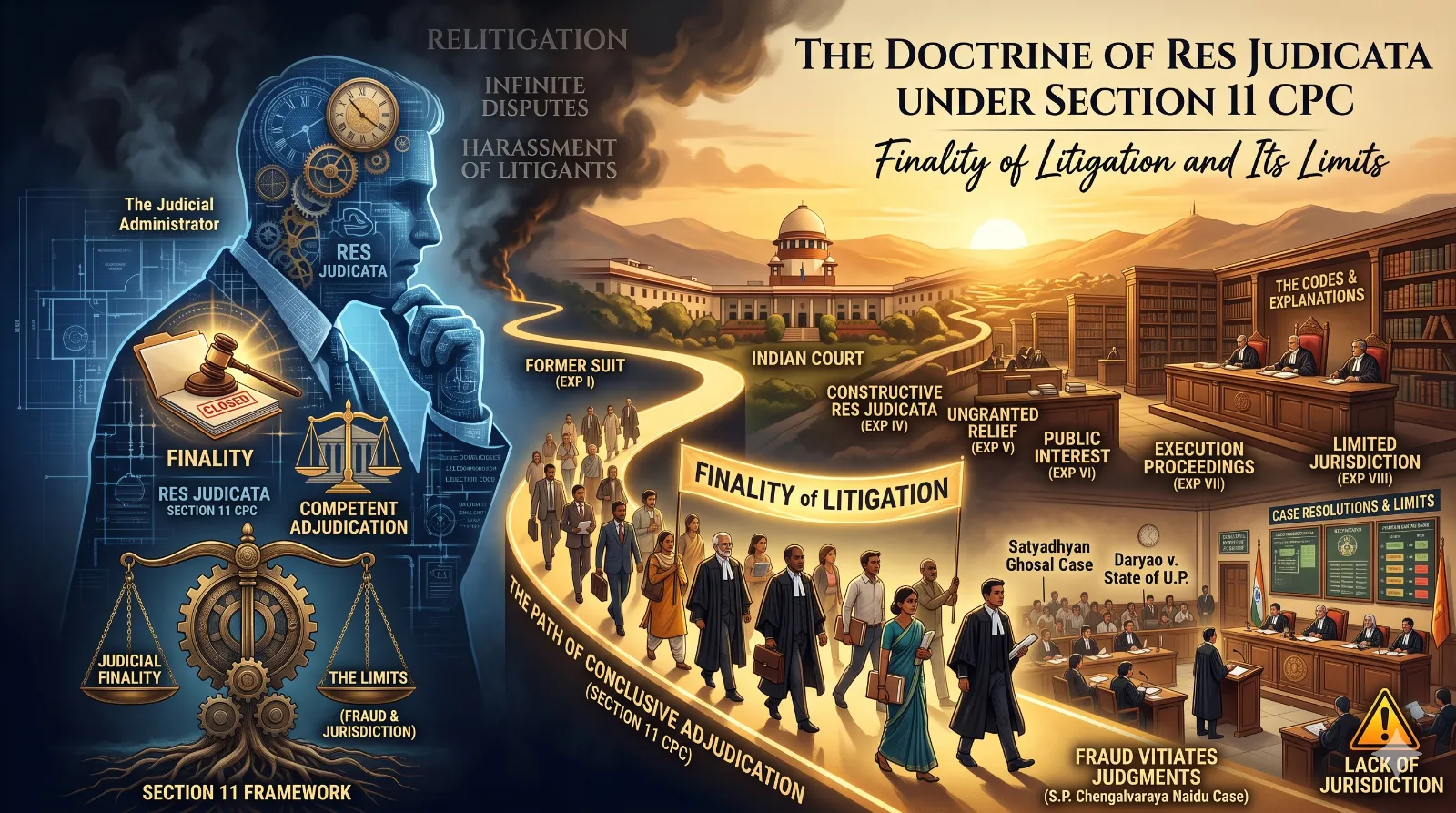
The Doctrine of Res Judicata under Section 11 CPC: Finality of Litigation and Its Limits
Courts exist to resolve disputes, not to keep them alive indefinitely. Section 11 of the Code of Civil Procedure, 1908 (CPC), embodies this principle through the doctrine of res judicata, which prevents parties from reopening matters that have already been finally decided by a competent court. The doctrine protects litigants from repeated proceedings, preserves judicial resources, and gives authority to judicial decisions. However, applying res judicata requires more than establishing that two cases concern similar facts. The nature of the earlier decision, the identity of the parties, the issues adjudicated, and the competence of the court must all be examined. The eight Explanations appended to Section 11 clarify the scope of the doctrine and address situations in which a matter may be treated as already decided, even when it was not expressly determined in the earlier proceedings.
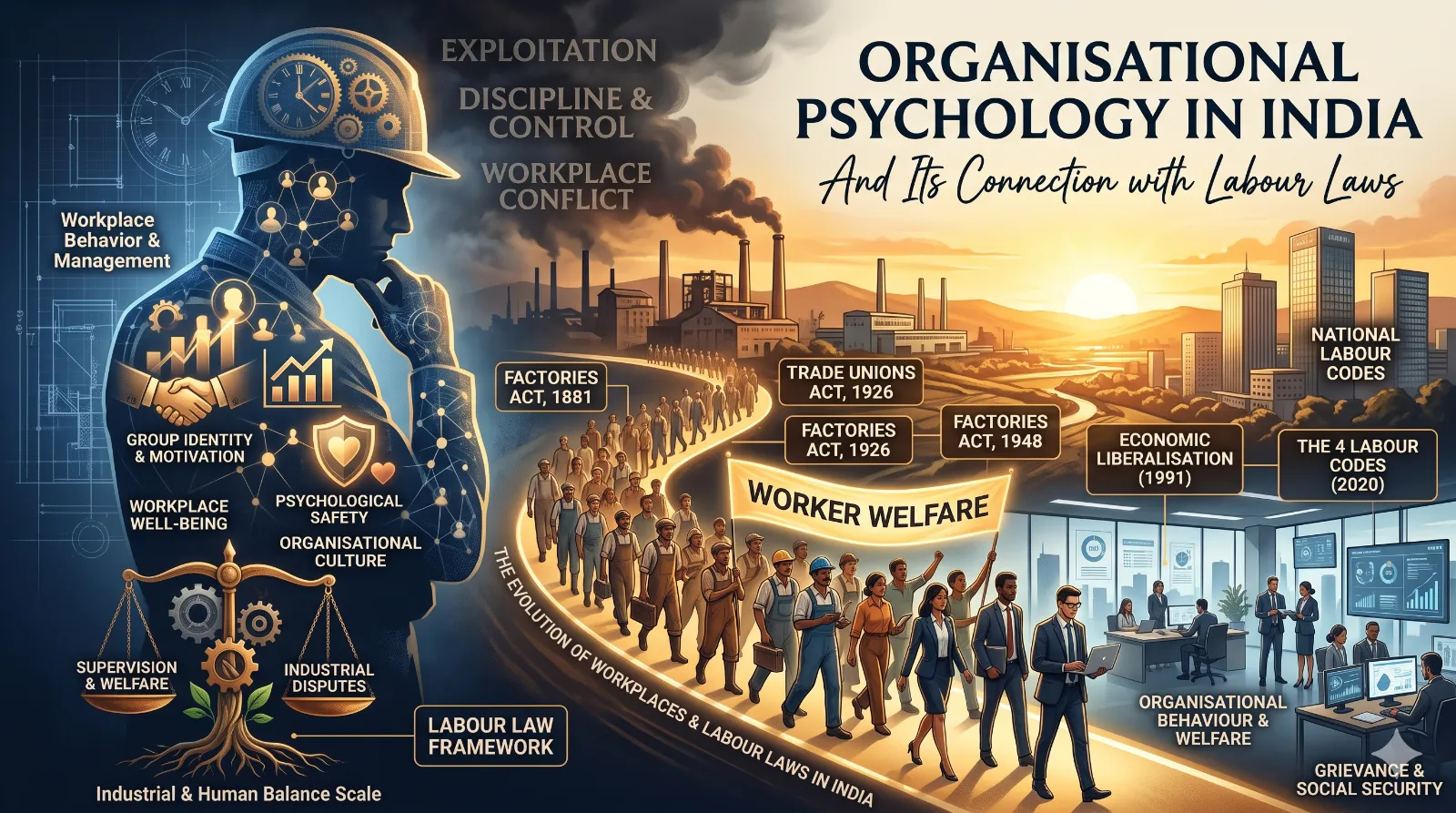
The History of Organisational Psychology in India and Its Connection with Labour Laws
Organisational psychology examines how people behave within organisations, how management influences their performance, and how workplace relationships affect decisionmaking. In India, its development can be understood alongside the country's industrial history, from colonial-era factories to modern corporate workplaces. Although organisational psychology emerged as a distinct discipline largely through Western research, the questions it addresses became increasingly relevant in India as industrial employment expanded and concerns about working conditions, worker representation, and managerial authority grew. The history of Indian labour legislation provides a useful timeline for understanding how the relationship between organisations and the people working within them has changed. From Industrial Control to Human Behaviour 1881–1947: Colonial industrialisation and factory regulation The expansion of factories, railways, mines, and plantations under British rule created a growing need to organise industrial labour. Early management practices emphasised discipline, productivity, and supervision, while workers faced concerns about working hours, safety, and welfare. The Factories Act, 1881, marked an early attempt to regulate factory employment in India. It was followed by further legislation, including the Factories Act, 1948, which developed a broader framework for factory health, safety, and welfare.
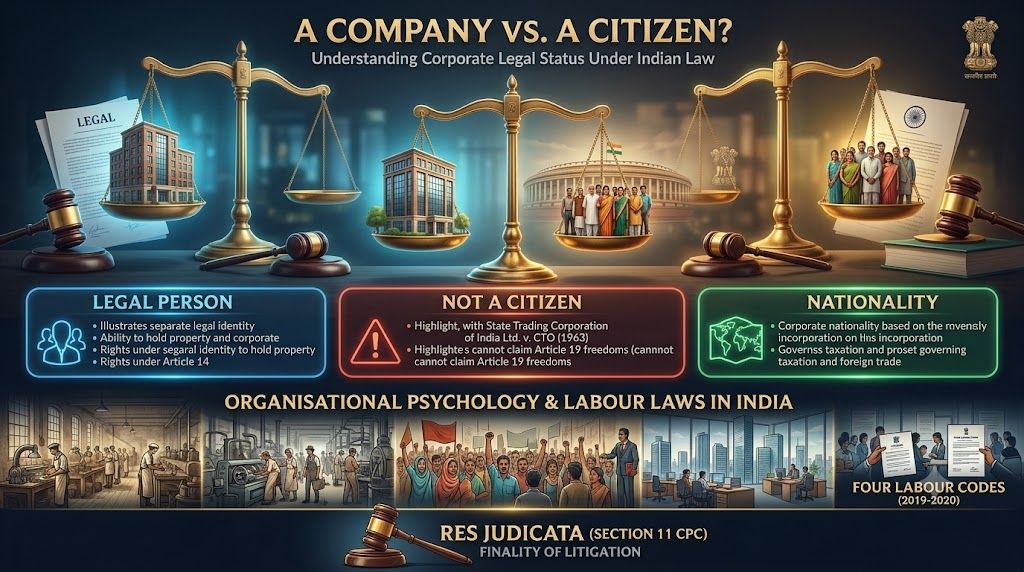
Is a Company a Citizen or a National? Understanding the Position Under Indian Law
Can a company incorporated in India claim the same constitutional status as an Indian citizen? At first glance, the answer might appear obvious. A company may be established under Indian law, conduct business within the country, employ Indian citizens, and contribute significantly to the national economy. Yet, despite its distinct legal identity, a company does not enjoy every right available to an individual. This distinction came into sharp focus before the Supreme Court of India in State Trading Corporation of India Ltd. v. Commercial Tax Officer, AIR 1963 SC 1811, a landmark judgment that clarified the constitutional position of companies and established an important distinction between legal personality, citizenship, and corporate nationality.